
A cry to the world: a Palestinian mother is killed every half hour and 20,000 children are born in hell

- Europe and Arabs
- Saturday , 20 January 2024 18:17 PM GMT
Brussels - Capitals: Europe and the Arabs
UN Women said that the crisis in Gaza is affecting women and girls at catastrophic and unprecedented levels in terms of loss of life and scale of humanitarian needs. The Commission indicated that more than 24,600 Palestinians were killed in Gaza, according to the Ministry of Health in the Strip, including 16,000 women and children.
This came in a study issued by UN Women on the impact of the crisis in Gaza on gender. In it, she noted that women and children represent about 70% of the people killed in Gaza, including two women who have been killed every hour since the beginning of the current crisis.
Sima Bahouth, Executive Director of UN Women, said in a press statement: “We have seen evidence once again that women and children are the first victims of conflict and that our duty to seek peace is a duty towards them. We are failing them.” She added that this betrayal and trauma - which has befallen the Palestinian people over the past 100 days and continues - "will haunt us all for generations."
Gender-related concerns
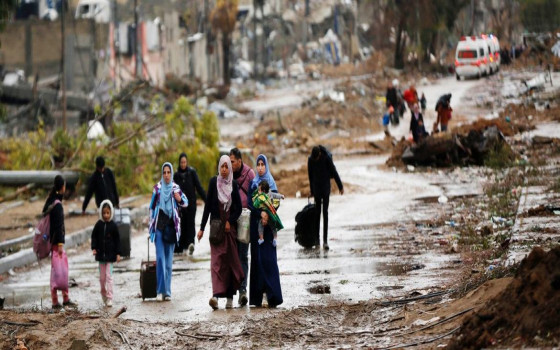
The commission's statement said that Gaza is witnessing a protection crisis for women. She pointed out that among the 1.9 million displaced people, there are nearly a million women and girls seeking refuge in dangerous shelter conditions, but there is no safe place in Gaza.
UN Women said that difficult decisions about eviction, how to do it, when and where to go, are rooted in gender-differentiated fears and experiences, as gender-related risks, including attacks and harassment, emerge along displacement routes.
UN Women estimates that “at least 3,000 women may have become widows and heads of families, and are in dire need of protection and food assistance. At least 10,000 children may have lost their fathers. In this context, more women fear that they will resort to Families resort to desperate coping mechanisms, including early marriage.”
Life-saving support
Through the six-month humanitarian response plan, UN Women in Palestine provided life-saving assistance such as emergency food assistance to more than 14,000 female-headed households - a third of all female-headed households in Gaza - and supported the distribution of clothing, sanitary products and infant formula.
UN Women collaborates with women-led organizations to provide gender-responsive services related to gender-based violence, establish women-led protection and response committees in women’s shelters for displaced women, and holds regular consultations with women’s organizations in Palestine to discuss the challenges they face.
The Commission continues to call for an immediate humanitarian ceasefire and spare no effort to ensure the protection of women and girls and safe access to rapid, unhindered and gender-responsive humanitarian assistance. It reiterated its deep concern at the horrific accounts of sexual and other forms of gender-based violence during the October 7 attacks, and called for accountability, justice and support for all those affected, and for the immediate and unconditional release of all hostages.
United Nations humanitarian workers warned on Friday that children are being “born in hell” in Gaza, and that many more children are likely to die as a result of the increasingly harsh conditions in the Strip.
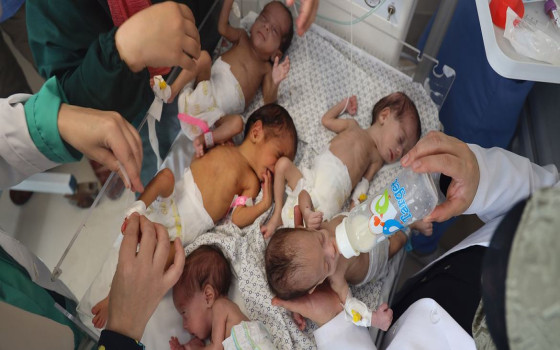
The United Nations Children's Fund (UNICEF) reported that there have been nearly 20,000 births since the start of the widespread Israeli bombing in the Gaza Strip. She stressed that chronic problems in accessing aid led to caesarean sections being performed without anesthesia, while other women were unable to give birth to their children who died in the womb due to excessive pressure on the medical staff.
“Mothers face unimaginable challenges in accessing appropriate medical care, nutrition and protection before, during and after birth,” UNICEF Communications Specialist Tess Ingram said at the press conference for UN agencies in Geneva, UNICEF Communications Specialist Tess Ingram said via video from Amman. She added, "Becoming a mother should be a time to celebrate. In Gaza, it is another child born in hell."
A situation beyond belief
In order to help the most vulnerable women and children in Gaza, UNICEF has delivered formula and nutritional supplements to mothers who cannot breastfeed, along with medical supplies for overwhelmed medical teams, but much more is needed.
Tess Ingram, who had just returned from southern Gaza, explained that workers at the overcrowded Emirati Hospital in Rafah had to remove mothers from the hospital “within three hours after the caesarean section was performed,” a situation that “beyonds belief and requires immediate action.”
She added that the ongoing bombing and displacement "directly affects newborn children, leading to high rates of malnutrition, growth problems, and other health complications." The UN official said that it is believed that about 135,000 children under the age of two are currently at risk of acute malnutrition, amid “inhumane” conditions in temporary shelters, malnutrition and unsafe water.
"Seeing newborns suffering, while some mothers bleed to death, should keep us all up at night," she added. She also said, "Knowing that two young Israeli children kidnapped on October 7 have not yet been released should also keep us awake."
Recording cases of hepatitis C
In turn, the Director-General of the World Health Organization, Dr. Tedros Adhanom Ghebreyesus, expressed concern about the confirmation of cases of hepatitis A in Gaza. “Inhumane living conditions, where there is barely any clean water and clean toilets and the surroundings are (un)able to keep clean, will enable the spread of hepatitis A further, highlighting how dangerous the environment is,” Dr. Tedros said in a post on the X website. "(There) is a massive spread of disease."
The latest WHO data indicates that on average, 500 people share one toilet, and more than 2,000 people are forced to use one bathroom, increasing the risk of spreading the disease. The organization reported that in addition to the sharp rise in upper respiratory infections, the cases of diarrhea among children under the age of five recorded during the last three months of 2023 were 26 times higher than what was recorded for the same period in 2022.
At the press conference held on Friday at the United Nations office in Geneva, World Health Organization spokesman Tarik Jasarevic said that people are being pushed into smaller spaces than ever before, where they are staying in overcrowded shelters with no access to clean water, or to toilets. .
The UN official added that a large segment of the population in Gaza, including people who were injured and exposed to bombing, "need immediate medical assistance." He pointed out that the Nasser Medical Complex in Khan Yunis had only two doctors left in the emergency department, compared to 24 doctors before the war, with only 14 intensive care beds today, compared to 45 beds, and only four nurses out of 20 before the escalation.




No Comments Found