

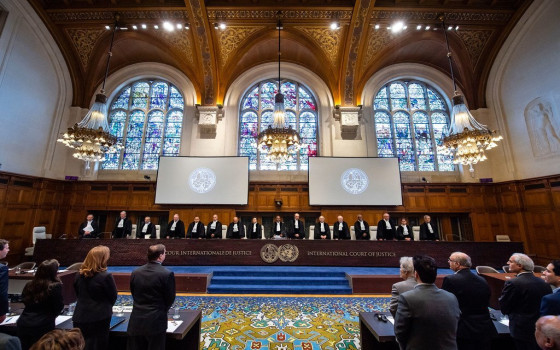
Tomorrow is the decision of the International Court of Justice on the measures requested by South Africa regarding Israel’s practices in Gaza

- Europe and Arabs
- Thursday , 25 January 2024 17:27 PM GMT
The Hague - New York: Europe and the Arabs
The International Court of Justice announced that it will issue its decision tomorrow, Friday (January 26), regarding the “interim measures” requested by South Africa in its case against Israel related to the application of the Convention on the Prevention and Punishment of the Crime of Genocide in the Gaza Strip. This came in a statement, a copy of which we received via E-mail
The court stated that it will hold a public hearing at one o'clock in the afternoon on Friday in The Hague, Netherlands, during which the president of the court, Judge John Donahue, is scheduled to read the court's decision.
South Africa filed its case against Israel on December 29 over “allegations that Israel has committed violations of its obligations under the Convention on the Prevention and Punishment of the Crime of Genocide with respect to the Palestinians in the Gaza Strip.”
According to the UN news bulletin on Thursday morning, South Africa also asked the court to issue temporary measures to prevent further harm to the rights of Palestinians and to ensure Israel's compliance with its obligations under the agreement.
What “interim measures” does South Africa request from the court?
“Interim measures” are described as orders issued by a court before its final ruling in a case, with the aim of preventing irreparable damage. Under it, the defendant state is obligated to refrain from taking certain measures until the court issues the final ruling.
South Africa asked the International Court of Justice to indicate nine interim measures in relation to the Palestinian people as a protected group under the Genocide Convention.
At the beginning of Thursday's public hearing, the court clerk read out the nine measures, which we summarize in the following points:
First, the State of Israel must immediately suspend its military operations in and against Gaza.
Secondly, Israel must ensure that no steps are taken in furtherance of those military operations.
Third, both the Republic of South Africa and the State of Israel, in accordance with their obligations under the Convention on the Prevention and Punishment of the Crime of Genocide - with respect to the Palestinian people - must take all reasonable measures within their powers to prevent genocide.
Fourth, the State of Israel must, in accordance with its obligations under the Convention, refrain from committing any of the acts that fall within the scope of Article 2 of the Convention, in particular:
(a) Killing members of the group.
(b) Causing serious physical or mental harm to members of the group.
(c) Intentionally subjecting the group to living conditions intended to cause its physical destruction, in whole or in part.
(d) Imposing measures aimed at preventing the birth of children within the group.
Fifth, the State of Israel must, with regard to the Palestinians, cease taking all measures, including the repeal of relevant orders, restrictions and/or prohibitions. To prevent:
(a) Their expulsion and forced displacement from their homes;
(b) Deprivation of:
1- Obtaining adequate food and water;
2- Access to humanitarian assistance – including adequate fuel, shelter, clothing, hygiene and sanitation;
3- Medical supplies and assistance;
(c) Destruction of Palestinian life in Gaza.
Sixth, the State of Israel must ensure that it does not commit any acts described in points (4) and (5) or participate in direct and public incitement or attempt to commit genocide, or conspire or be complicit in it.
Seventh, the State of Israel must take effective measures to prevent the destruction of evidence relating to the allegations, and to ensure its preservation. To this end, Israel must not prevent or restrict the access of fact-finding missions, international mandates and other bodies to Gaza.
Eighth, Israel must report to the Court on all measures taken to implement this order (under interim measures) within one week, from the date of its issuance, and thereafter at regular intervals as the Court orders, until it issues its final decision in the case.
Ninth, the State of Israel must refrain from any action and ensure that no action is taken that may aggravate or prolong the dispute before the Court or make its resolution more difficult.



No Comments Found