

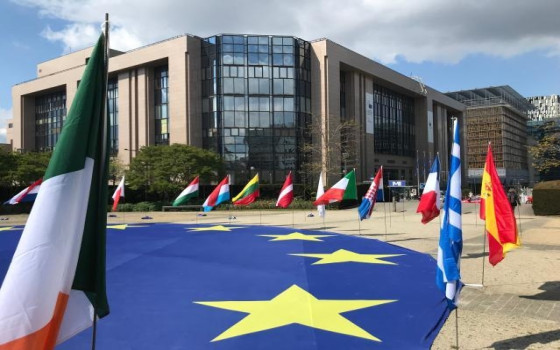
A meeting of the Ministers of Interior and Justice from the European Union and partner countries to discuss issues of immigration and asylum, combating drug trafficking, and the harmful use of artificial intelligence.

- Europe and Arabs
- Wednesday , 31 January 2024 16:14 PM GMT
Brussels: Europe and the Arabs
A statement issued by the current Belgian Presidency of the European Union yesterday said that the last meeting, which was hosted by the Union Presidency last week and included ministers of interior and justice from European Union member states, countries associated with the Schengen Area, partners and European institutions, focused on internal affairs and migration. The Minister of State for Asylum and Migration confirmed in Belgium, Nicole De Moor, said that its main priority is to finalize the legal texts of the new European Charter on Asylum and Migration and begin the process of its implementation and activation.
It is crucial that this historic reform is not only agreed on paper, but it will also fundamentally change the way we deal with migration and asylum on the ground. The agreement will not change the situation on the ground from the first day of its adoption. But there is a full commitment to implementing the decisions and taking concrete steps in this direction. The reforms will ultimately lead to better migration management.
Migration ministers from EU member states also discussed the future of Ukrainian refugees, and possible complementary or alternative avenues for temporary protection measures. The war is not over yet, but the temporary protection is currently expected to end in 2025. Good politicians need to be prepared for the future. The ministers noted their commitment to Ukraine and its citizens and stressed the need for European coordination in this area. They agreed with the Presidency that adopting 27 different national pieces of legislation on this topic would be counterproductive, lead to secondary movements, and cause uncertainty. The Commission and Member States decided to continue this discussion, including with the Ukrainian authorities, in order to take a joint decision in the near future.
Combating illicit drug trafficking and misuse of artificial intelligence
Belgian Home Affairs Minister Annelies Verlinden has put efforts to tackle organized crime and the malicious use of artificial intelligence (AI) on the agenda.
The fight against international organized drug crime is one of the main priorities of the Belgian Presidency of the Council of the European Union. Based on the European Union Roadmap, ten priority actions have been identified that will guide efforts over the coming months. One of these priorities is to enhance the flexibility of logistics platforms.
The statement of the Belgian Presidency of the Union indicated that on January 24, an important stage was reached, represented by the launch of the European Ports Alliance, which is a partnership between the public and private sectors. This partnership will bring together public and private stakeholders in our ports to identify pragmatic and practical solutions to prevent criminal networks from infiltrating European ports and using them to traffic drugs. The need to further develop and implement the administrative approach, which allows local authorities to take concrete measures (such as denying licenses or permits) to prevent organized crime networks from exploiting our legal business structures and undermining the legal economy, was also discussed. The issue of preventing the recruitment of minors by criminal networks was also discussed. To protect minors and stop this alarming trend, it is necessary to invest in effective crime prevention policies and tools.
Another discussion focused on deepfakes, misinformation and disinformation, the use of artificial intelligence by criminal organizations and the impact on law enforcement. AI can be used to leverage misinformation to manipulate public opinion, undermine trust in society, and promote polarization. The year 2024 holds great significance as an election year, with a record number of voters turning out at the polls globally. This underscores the timeliness and importance of the ongoing discussion. Artificial intelligence cannot be used as a catalyst for polarization and extremism.
Discussions have shown that there is a need to invest in appropriate tools and advanced security measures as cyber attacks will become increasingly more sophisticated. Our law enforcement authorities and the broader community need to have the opportunity to learn the appropriate skills to understand the capabilities, risks, and limitations of artificial intelligence. Only education can create the resilience and, ultimately, the resources needed to combat the harmful use of AI.





No Comments Found