

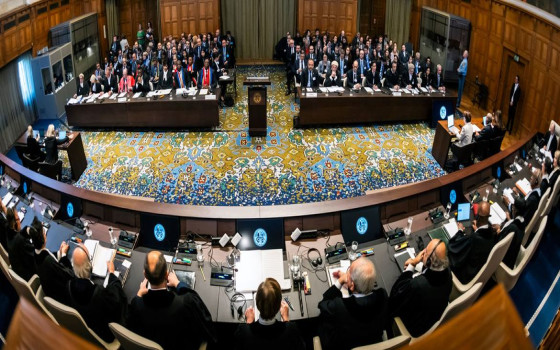
Today, the International Court of Justice begins public hearings on the practices of the Israeli occupation against the Palestinians

- Europe and Arabs
- Monday , 19 February 2024 13:12 PM GMT
The Hague: Europe and the Arabs
On Monday, the International Court of Justice in The Hague, Netherlands, will begin holding public hearings on the legal consequences arising from Israel’s policies and practices in the Occupied Palestinian Territory, including East Jerusalem.
The sessions come in the context of the United Nations General Assembly’s request to obtain a fatwa from the court on the effects of the Israeli occupation that has continued for more than 57 years, and will continue for six days between 19 and 26 February.
During the sessions, the court is scheduled to hear briefings from 52 countries - an unprecedented number in the history of the court - in addition to the African Union, the Organization of Islamic Cooperation, and the League of Arab States.
Request a legal opinion
The General Assembly had submitted a request for an advisory opinion from the Court in a resolution it adopted in late December 2022 on the legal consequences “arising from Israel’s continued violation of the right of the Palestinian people to self-determination, and from its long-term occupation, settlement and annexation of the Palestinian territory occupied since 1967, including These include measures aimed at changing the demographic composition, character and status of the City of Al-Quds Al-Sharif, and its adoption of discriminatory legislation and measures in this regard.”
Different paths
The proceedings before the court next week differ from the case brought by South Africa against Israel over what it described as Israel's non-compliance with the Convention on the Prevention of Genocide in the Occupied Palestinian Territory during its military campaign following attacks carried out by Hamas and Palestinian factions on October 7, 2023, which led to The majority of Gaza's population was displaced and about 28,000 Palestinians were killed in just over four months.
Although advisory opinions issued by the International Court of Justice are non-binding, they can carry significant moral and legal authority and can eventually become part of the norms of international law, legally binding on states.
Two decades since the wall fatwa
The General Assembly had requested a legal advisory opinion on Israeli actions in the occupied territories in December 2003 regarding the construction of the separation wall in the West Bank, including East Jerusalem. A few months later, in July 2004, the court found that construction of the wall contravened international law and must stop, and that the parts that had been built must be dismantled.
These proceedings provide the Court with the opportunity to provide - two decades after its last advisory opinion - a more comprehensive assessment of the practices of the Israeli occupation, and to advise on the application of international humanitarian law, human rights law, and international criminal law.
Today, Monday, will witness the opening of the hearings in The Hague and the statement of the State of Palestine. Israel was among 57 countries and international organizations that submitted written statements to the court by the deadline it set of July 25, 2023, and decided not to participate in the oral hearings.
It is noteworthy that the International Court of Justice is the main judicial body of the United Nations, and consists of 15 judges who are elected for a nine-year term by the General Assembly and the UN Security Council.








No Comments Found