

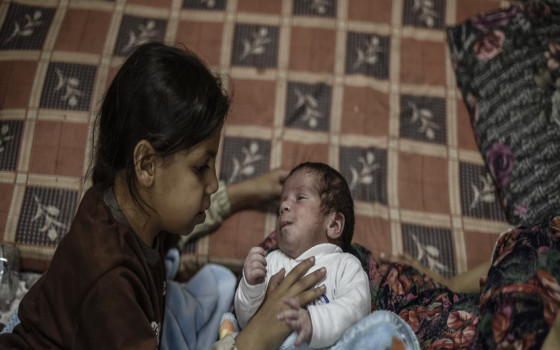
Hunger and disease are a deadly combination for the children of Gaza and pregnant and breastfeeding women. Food and potable water are a rare currency.

- Europe and Arabs
- Tuesday , 20 February 2024 14:52 PM GMT
Gaza - New York: Europe and the Arabs
The United Nations Children's Fund (UNICEF) has warned that the sharp rise in malnutrition among children and pregnant and lactating women poses a serious threat to their health as the devastating war continues in the Gaza Strip. According to what was stated in the United Nations daily news bulletin, a copy of which we received on Tuesday morning
After twenty weeks of continuous conflict and destruction, food and potable water have become extremely scarce in the Gaza Strip, while diseases are spreading, putting the nutrition and immunity of women and children at risk and leading to a sharp rise in acute malnutrition.
This warning comes after a report issued yesterday by the Global Nutrition Cluster - led by UNICEF - showed that one in every six children under the age of two suffers from acute malnutrition in northern Gaza, where aid has been almost completely cut off for weeks.
The report indicated that even in Rafah, where aid was more available, five percent of children in the same age group faced the same suffering. UNICEF noted that the data used in the report was collected in January, and the situation is now likely to be more dire.
'Explosion in child deaths'
Ted Chaiban, deputy executive director of UNICEF, said Gaza is about to witness “an explosion in preventable child deaths, which will double the already unbearable level of child mortality.” He recalled that UNICEF had warned that the Strip was “on the brink of a nutrition crisis,” and warned that if the conflict did not end now, “child nutrition will continue to deteriorate, leading to preventable deaths or health problems that will affect the children of Gaza for life and have potential consequences across generations.” ".
UNICEF confirmed that the deterioration in the nutritional status of Gazans is “unprecedented in the world,” with 95 percent of families limiting their meals and sizes, and 64 percent eating only one meal a day. In addition, more than 95 percent of families reported that they limit the amount of food that adults receive in order to ensure that young children have food to eat.
Valerie Guarnieri, assistant executive director of the World Food Programme, said the sharp rise in malnutrition rates in Gaza is “dangerous and entirely preventable.” She stressed the need for critical improvements in security and humanitarian access, increasing the number of crossings for aid into Gaza and ensuring women and children have access to healthy foods, clean water, health and nutrition services.
Hunger and disease are a deadly combination
The report found that at least 90 percent of children under the age of five in Gaza have infectious diseases, and 70 percent have had diarrhea in the past two weeks, a 23-fold increase compared to 2022.
Dr Mike Ryan, Executive Director of the World Health Organization's Health Emergencies Programme, said: “Hunger and disease are a deadly combination. Hungry, weak and traumatized children are more vulnerable to illness, and sick children, especially those with diarrhoea, cannot absorb nutrients well. It is dangerous.” "It's tragic and it's happening before our eyes."
UNICEF, the World Food Program and the World Health Organization called for urgent, safe, unhindered and sustainable access to multi-sectoral humanitarian assistance throughout the Gaza Strip. They stressed the need to protect hospitals and health workers from attacks so that they can provide treatment and critical care safely. She also noted that an immediate, humanitarian ceasefire still provides the best opportunity to save lives and end suffering.





No Comments Found