

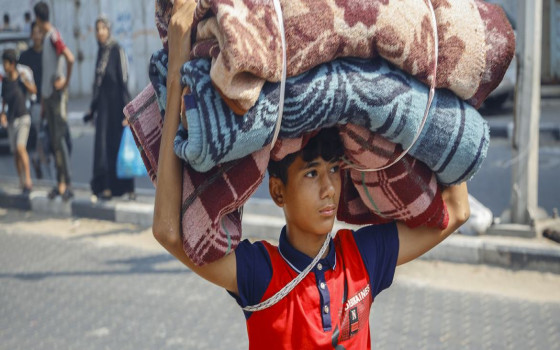
UN and international officials are calling for preventing a worse catastrophe in Gaza

- Europe and Arabs
- Thursday , 22 February 2024 14:48 PM GMT
Gaza - New York: Europe and the Arabs
Civilians in Gaza are in grave danger as the world watches, the heads of 19 UN and international agencies said, setting out ten requirements in order to avoid a worse catastrophe. They also reiterated that there is no safe place in Gaza, and called on world leaders to "prevent a worse catastrophe."
This came in a joint statement issued by the Inter-Agency Standing Committee, the highest platform for humanitarian coordination in the United Nations system. According to what was reported in the United Nations daily news bulletin, a copy of which we received on Thursday morning
Officials explained that in less than five months after the brutal attacks on October 7 and the escalation that followed, tens of thousands of Palestinians, most of them women and children, were killed and wounded in the Gaza Strip.
They added that more than three-quarters of the population have been forced to leave their homes several times, and face severe shortages of food, water, sanitation and health care, which are the basic necessities for survival.
The health system continues to systematically deteriorate, with disastrous consequences, officials said, noting that as of February 19, only 12 of the 36 hospitals with inpatient capacity were partially functioning.
The statement stated that more than 370 attacks targeted health care facilities in Gaza since October 7.
Knockdown
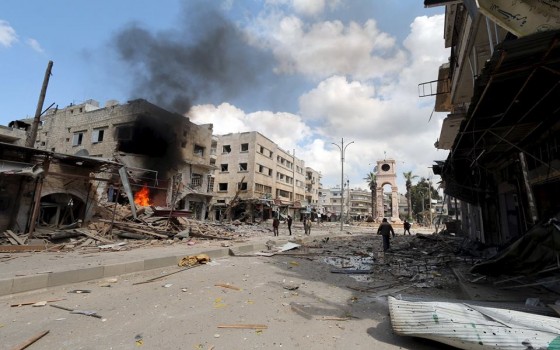
The heads of UN and international agencies explained in their statement that diseases are rampant, famine looms on the horizon, water is scarce, basic infrastructure has been destroyed, food production has stopped, hospitals have turned into battlefields, and a million children face daily trauma.
They added that Rafah, which has become the final destination for more than a million displaced, hungry and traumatized people crammed into a small piece of land, has turned into another battlefield in this brutal conflict.
They warned that further escalation of violence in this densely populated region would cause large numbers of casualties, and could also deal a fatal blow to the already suffering humanitarian response.
They said humanitarian workers - themselves displaced and facing bombing, death, restrictions on movement and the collapse of civil order - are continuing their efforts to deliver aid to those in need. But they warn that in the face of many obstacles, including safety and movement restrictions, there is little they can do.
Rescue humanitarian operation
The officials said in a statement by the Inter-Agency Standing Committee that no amount of humanitarian response will compensate for the months of deprivation that families in Gaza have suffered.
They reported that in order to save the humanitarian operation so that they can at the very least provide basic needs, including medicine, drinking water, food and shelter as temperatures drop, they need the following:
Immediate ceasefire.
Protecting civilians and the infrastructure on which civilians depend.
Release the hostages immediately.
Reliable entry points allowing aid to enter from all possible crossings, including into northern Gaza.
Security guarantees and unhindered passage to distribute aid, on a large scale, throughout Gaza, without refusal, delay or obstacles to access.
An effective humanitarian notification system allows all humanitarian workers and supplies to move within Gaza and deliver aid safely.
Roads must be passable and neighborhoods must be cleared of explosive ordnance.
A stable communications network allows humanitarian workers to move in safety and security.
UNRWA, the backbone of humanitarian operations in Gaza, receives the resources it needs to provide life-saving assistance.
Stop campaigns that seek to discredit the United Nations and NGOs doing their best to save lives.
Officials stressed that humanitarian agencies remain committed to doing their work, despite the risks, but they cannot be left alone to deal with the situation.
The officials called on Israel to fulfill its legal obligations, under international humanitarian law and human rights law, to provide food and medical supplies and facilitate aid operations.
The signatory officials to the joint statement are:
Martin Griffiths, Emergency Relief Coordinator and Under-Secretary-General for Humanitarian Affairs (OCHA)
Sophia Sprickman, Secretary General of CARE International
Qu Dongyu, Director-General of the Food and Agriculture Organization of the United Nations (FAO)
Jane Buckhurst, President (Christian Aid)
Jamie Moon, Executive Director, International Council of Voluntary Agencies
Tom Hart, CEO and President of Inter Action
Amy Pope, Director-General of the International Organization for Migration
Tejada Doyon McKenna, CEO of Mercy Corps
Volker Türk, United Nations High Commissioner for Human Rights
Janti Soerpto, President of Save the Children
Paula Gaviria Bettencourt, UN Special Rapporteur on the human rights of internally displaced persons
Achim Steiner, Administrator of the United Nations Development Programme
Natalia Kanem, Executive Director of the United Nations Population Fund
Filippo Grandi, United Nations High Commissioner for Refugees
Michel Mlinar, Acting Executive Director of the United Nations Human Settlements Program (UN-Habitat)
Catherine Russell, Executive Director of the United Nations Children's Fund (UNICEF)
Sima Bahouth, Under-Secretary-General and Executive Director of UN Women
Cindy McCain, Executive Director of the World Food Programme
Dr. Tedros Adhanom Ghebreyesus, Director-General of the World Health Organization.





No Comments Found