
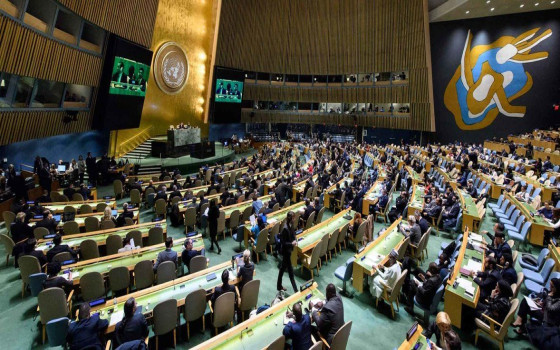
Members of the Security Council affirm their strong commitment to a comprehensive political process in Libya
- Europe and Arabs
- Wednesday , 28 February 2024 15:36 PM GMT
New York: Europe and the Arabs
The members of the UN Security Council reaffirmed their strong commitment to an inclusive political process led and owned by Libyans, facilitated by the United Nations, and building on the updated electoral laws approved by the 6+6 Committee, which will enable free, fair, transparent and inclusive national presidential and parliamentary elections to be held throughout Libya as soon as possible. Available time.
This came in a statement issued by the Security Council, yesterday, Tuesday, in which its members reiterated their strong support for the Special Representative of the Secretary-General of the United Nations in Libya and the head of the United Nations Support Mission in Libya (UNSMIL), Abdullah Batili, especially his role in mediation and good offices to promote a political process. Comprehensively, in line with relevant Security Council resolutions, and building on the Libyan Political Agreement and the roadmap of the Libyan Political Dialogue Forum, in addition to the updated electoral laws approved by the 6+6 Committee.
According to what was stated in the daily United Nations news bulletin, a copy of which we received via email on Wednesday morning, Council members called for full support for the Special Representative of the Secretary-General and the United Nations Support Mission in Libya in implementing their mandate. They affirmed their support for the efforts of the Special Representative of the Secretary-General to meet with relevant Libyan institutions to support progress towards holding free, fair, transparent and inclusive national presidential and parliamentary elections across Libya as soon as possible, including by ensuring the equal, meaningful and safe participation of women at all levels.
The members of the Security Council called on all key stakeholders to fully engage with the Special Representative of the Secretary-General in good faith and without preconditions, and to make the necessary concessions to move the country forward towards elections.
A comprehensive reconciliation process
In their statement, the members of the Security Council stressed the importance of achieving tangible progress on security, economic and political tracks, international humanitarian law and human rights, stressing the importance of providing a safe environment for civil society organizations to operate freely and protecting them from threats and reprisals.
The members of the Security Council noted that individuals or entities who threaten the peace, stability or security of Libya, or obstruct or undermine the successful completion of the political transition process - including by obstructing or undermining elections - may be placed on Security Council sanctions lists.
Council members stressed the importance of a comprehensive reconciliation process based on the principles of transitional justice and accountability, and welcomed the efforts of the Presidential Council to launch the national reconciliation process, with the support of the African Union, including facilitating the holding of the national reconciliation conference scheduled for April 28 in the city of Sirte.
The members of the Security Council once again expressed their strong support for Libya's sovereignty, independence, territorial integrity and national unity. They renewed their call for the withdrawal of all foreign forces, foreign fighters and mercenaries from Libya without delay, in line with the provisions of the ceasefire agreement signed on 23 October 2020 and Security Council resolutions 2701 (2023) and 2702 (2023).
They expressed their concern in light of the increasing tensions in Libya, including the spread of armed militias. The members of the Security Council indicated in their statement that the successful completion of the political transition process in Libya provides the best opportunity to bring peace, stability and security to the Libyan people.


No Comments Found