

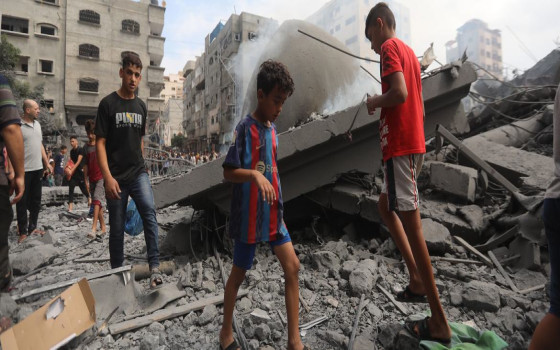
Gaza: Air strikes continue, concern about the possibility of losing a generation of children, and expectations of increased tragedy during the month of Ramadan.

- Europe and Arabs
- Tuesday , 5 March 2024 16:27 PM GMT
Gaza - Cairo: Europe and the Arabs
Jamie McGoldrick, the United Nations Humanitarian Coordinator in the Occupied Palestinian Territory, continues on Tuesday a two-day visit to Gaza that began yesterday, Monday, as United Nations spokesman Stephane Dujarric announced at the daily press conference.
Dujarric said that Jimmy McGoldrick met in Rafah, earlier yesterday, with local community leaders and others, who expressed their concerns about the impact of the crisis on women's health, as well as the possibility of losing a generation of children, who have been out of school for several months. Dujarric explained that McGoldrick will brief reporters in New York on Wednesday from Jerusalem. According to what was stated in the daily news bulletin of the United Nations
In a related development, Sikhrid Kach, the United Nations Chief Coordinator for Humanitarian Affairs and Reconstruction in Gaza, concluded a two-day visit to Egypt, during which she met with the Egyptian Foreign Minister, Sameh Shoukry, and other Egyptian officials. She also met with Ahmed Aboul Gheit, Secretary-General of the League of Arab States.
Stephane Dujarric said that Kach discussed during her meetings the necessity of implementing Security Council Resolution No. 2720 for the sake of all civilians in Gaza.
Grim conclusions
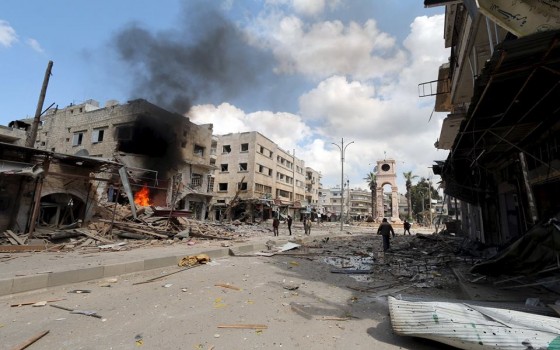
This comes in conjunction with reports of continued air strikes on the Strip, where dozens were killed and injured on Saturday when tents for displaced people next to the Emirati Hospital were bombed. Two of the dead were health workers.
On the other hand, a team consisting of the World Health Organization, the Office for the Coordination of Humanitarian Affairs, UNICEF and the United Nations Population Fund visited Al Awda and Kamal Adwan Hospital in northern Gaza yesterday, Sunday, with the aim of delivering fuel and basic medical supplies.
This was the first visit to the two hospitals since early October, despite ongoing UN efforts to reach northern Gaza more regularly. Dujarric said the team delivered 9,500 liters of fuel to the two hospitals – but said the amount of fuel is only a fraction of what is actually needed.
WHO Director-General Dr. Tedros Adhanom Ghebreyesus spoke of "bleak conclusions" during the team's visit - which included severe levels of malnutrition, children starving to death, the destruction of hospital buildings, and major shortages of fuel, food and medical supplies.
Kamal Adwan Hospital is the only children's hospital in northern Gaza and is overwhelmed with patients. Dr. Tedros said the lack of electricity poses a serious threat to patient care and the food shortage has caused the death of 10 children, doctors at the hospital told the WHO team.
For his part, UNRWA Commissioner-General Philippe Lazzarini said that 5% of Gaza's population were either killed, wounded, or lost track of them. He stated that the suffering of the population is impossible to adequately describe, as doctors are forced to amputate the limbs of injured children without anesthesia, hunger is spreading everywhere, and man-made famine looms on the horizon.
Mr. Adnan Abu Hasna, media advisor to UNRWA, said that he expects the ongoing tragedy in Gaza to increase during the holy month of Ramadan, reiterating the United Nations’ request for an immediate ceasefire for humanitarian reasons and allowing relief agencies to reach the northern Gaza Strip, which is witnessing “unprecedented humanitarian collapses.” "
The UNRWA official confirmed that air drops of aid cannot be an alternative to bringing trucks into Gaza via land, and they are not coordinated with the agency. He recalled that there are 7 border crossings into the Gaza Strip, stressing that if the political will is found to open them, UNRWA will be able to confront “the major humanitarian catastrophe besetting all the residents of the Gaza Strip.”





No Comments Found