
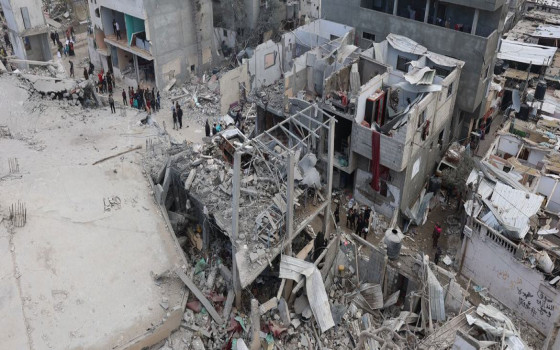
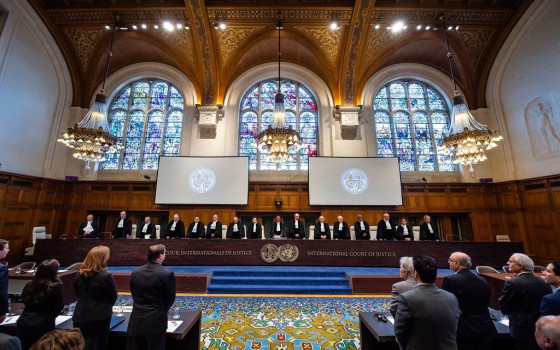
Before international justice...Israel responds today to South Africa, which said that institutional impunity allowed the occupation forces to commit the crime of genocide...Gaza: Warning that food and fuel will run out within days

- Europe and Arabs
- Friday , 17 May 2024 13:53 PM GMT
The Hague - Gaza: Europe and the Arabs - Agencies
Today, Friday, a second hearing will be held devoted to Israel’s response before the International Court of Justice to what was said by the South African ambassador to the Netherlands, Vusi Madonsela, yesterday, Thursday, in which he said that Israel has a mistaken belief that it is exempt from respecting international law due to the absence of measures taken by society to address its actions in Gaza. International, adding that "this institutional impunity pushed Israel to engage in this genocide, which shocked the conscience of humanity."
The ambassador's speech came at the opening of a public hearing before the International Court of Justice based on South Africa's request to issue additional temporary measures in the context of its accusation that Israel violates the Convention on the Prevention of Genocide in Gaza. Yesterday, Thursday, Mr. Madonsela told the court that the "Israeli genocide" in Gaza had just reached a "new and horrific stage." According to what was stated in the daily news bulletin of the United Nations, a portion of which we received this Friday morning
The South African ambassador said evidence of Israel's "genocidal intent" continues to mount, including calls by Israeli officials to "destroy the Palestinian people of Gaza," and incitement by Israeli civil society and other prominent figures.
He added: “This genocide comes in the context of the ongoing Nakba, the 76th anniversary of which was commemorated on Wednesday - the ongoing forced displacement of the Palestinian people, the erasure of the Palestinian presence in Palestine, and the replacement of the population with colonizers - a criminal process that took root and continued over 76 years of apartheid and 56 years of “There is no doubt that the constant scenes of Palestinians having to flee again and again for their lives are not only reminiscent of the Nakba of 1948, but are a continuation of it.”
An area unsuitable for humans
For his part, Professor von Loo of the South African legal team stressed that if the ICJ does not act now, “the possibility of rebuilding a viable Palestinian community in Gaza will be destroyed, at least for the lives of those who have survived the current atrocities in Gaza.”
The professor said it has become increasingly clear that Israel's actions in Rafah "are part of the end game in which Gaza is completely destroyed as an area unfit for human habitation. This is the final step in the destruction of Gaza and its Palestinian people." He said that while the events in Rafah forced South Africa to return to the court, “all Palestinians as a national and ethnic group need to be protected from the genocide that the court can order.”
This comes after humanitarian workers stressed yesterday, Thursday, the need to secure safe access to humanitarian supplies throughout Gaza so that relief teams can replenish their dangerously low stocks. This coincides with the International Court of Justice hearing today a new request from South Africa to issue more temporary measures regarding the Israeli military operation in the Gaza Strip.
The World Food Program warned that food and fuel stocks "will run out within days." He confirmed that since May 6, he had not been able to access and receive aid from the Kerem Shalom crossing area, stressing that "the situation has become unsustainable."
The UN agency stressed that any further escalation of hostilities in Gaza “may lead to an exacerbation of the humanitarian catastrophe and the cessation of relief operations.”
The World Food Program said it continues to distribute food aid despite significant challenges, “but in order to change the conditions leading to famine, a continuous flow of food supplies is needed, every day and every week, through multiple entry points.”
For its part, the United Nations Office for the Coordination of Humanitarian Affairs (OCHA) said that, as of May 15, “the Rafah crossing remains closed. The Kerem Shalom crossing is now operating, but the prevailing security and logistical conditions impede the delivery of humanitarian aid on a large scale.”
This assessment comes as UNRWA reported late Wednesday that 600,000 people - equivalent to a quarter of Gaza's population - have been forcibly displaced from Rafah since May 6 while the Israeli ground operation continues.



No Comments Found