
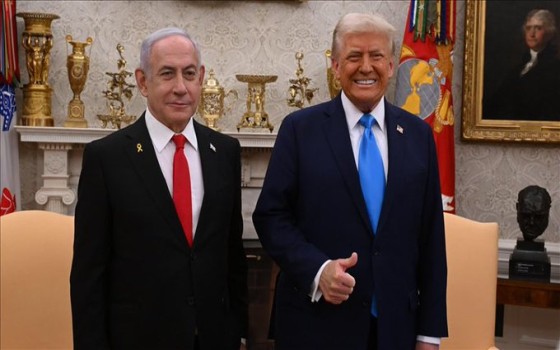
US-Israeli Coordination on Trump's Threats to Strike Iran... Turkish Proposal for a Trilateral Summit Bringing Together the US President, His Iranian Counterpart, and Putin to De-escalate Regional Tensions
- Europe and Arabs
- Friday , 30 January 2026 6:55 AM GMT
Tehran – Washington: Europe and the Arabs
International contacts continue in an attempt to avert an escalation of tensions surrounding the US threats to strike Iran. Ankara is hosting talks between Turkey and Iran today, Friday, in an effort to bring matters back to the negotiating table. This comes after Turkish President Recep Tayyip Erdoğan proposed to US President Donald Trump a trilateral summit between Turkey, the United States, and Iran aimed at reducing regional tensions and preventing a potential military escalation. According to the Italian news site Nova, the proposal was made during a phone call between the two leaders, which was largely dedicated to discussing the confrontation between Washington and Tehran. Turkish press reports indicate that Erdoğan stressed the need to address the crisis with Iran diplomatically before it escalates into armed conflict, proposing a meeting with Turkey's direct participation. The reports state that the Turkish president suggested a high-level meeting that could include US President Donald Trump, Iranian President Masoud Pezeshkian, and Erdoğan himself.
According to the reports, Trump welcomed the proposal with interest but has not yet given a final answer. Details of the potential summit, which could be held in person or virtually, as well as its date and location, remain unclear. This diplomatic initiative from Ankara comes amidst intense regional activity. Meanwhile, Turkish Foreign Minister Hakan Fidan stated that he held a phone conversation with his Iranian counterpart, Abbas Araqchi, who is expected to arrive in Turkey on Friday to discuss bilateral and regional issues. According to Turkish sources, Ankara's stated goal is to avert a new war and return the US-Iranian conflict to the path of dialogue, thus mitigating the risk of further escalation. Destabilizing the Middle East and regional security.
The political and military rhetoric between Washington and Tehran is escalating, coinciding with increasing field and political indicators suggesting the region is approaching a highly sensitive stage. Public warnings are intertwined with military movements, raising serious questions about the potential for a wider confrontation.
According to the European news network Euronews in Brussels, US Defense Secretary Pete Hegseth stated during a meeting with President Donald Trump at the White House that the United States would be prepared to carry out the president's orders. He added that Trump's assertion that Iran would not possess a nuclear weapon was a literal and unequivocal expression of this position. Hegseth also indicated that Tehran has all options for reaching a deal.
In the same context, Israel's Channel 12 quoted a well-informed source as saying that the head of Israeli military intelligence had arrived in Washington to coordinate a potential strike against Iran, noting the absence of any serious diplomatic negotiations with Tehran at present.
The source explained that Israel is coordinating with Washington on various scenarios for an attack on Iran and its anticipated repercussions.
The situation remains... Tensions in the Middle East are high due to the possibility of a US attack on Iran, following President Donald Trump's recent threat. Tehran responded by condemning what it called an "explicit threat" of force, while simultaneously seeking to leave room for negotiation. In a message posted on social media, Trump called for the deployment of the aircraft carrier USS Abraham Lincoln and its accompanying naval strike group to Iran, claiming the force was "ready" and "capable" of carrying out the mission, if necessary, "quickly and forcefully." In response, Iran's representative to the United Nations, Ambassador and Permanent Representative Amir Saeed Irvani, sent a letter to the Secretary-General and the President of the Security Council, describing Trump's statements as a "flagrant violation" of the UN Charter. He rejected and strongly condemned them, calling on the Security Council to take a "decisive" response. Irvani described the US president's statement as an "explicit and explicit threat" of force, "irresponsible and provocative," warning that such an approach could fuel regional escalation and increase the risk of miscalculation. He added that in the event of an attack or act of aggression, Tehran reserves the right to take "all necessary measures" to defend itself. Iran's sovereignty, territorial integrity, and the safety of its people were threatened, with Washington held responsible for the consequences.
In this context, however, Iranian Parliament Speaker Mohammad Bagher Ghalibaf attempted to soften his rhetoric, speaking of a conditional openness. In an interview with CNN, he said Tehran was ready to negotiate with the United States "if" the dialogue was "honest and genuine," but he also asserted that Trump would not seek such a confrontation, but rather aimed to impose his will. Ghalibaf also blamed "external forces" for the brutal crackdown on the recent protests, describing the demonstrations as a plan "designed abroad," and stated that the Islamic Republic would not back down from "avenging" the blood of the approximately 300 security personnel killed in the unrest. Meanwhile, the death toll from the crackdown remains highly contested: Iranian authorities put the number at around three, while NGOs report more than six victims, and opposition media estimate the number at around 30. On Thursday, EU foreign ministers agreed to add the Iranian Revolutionary Guard Corps to the "terrorist list," based on what the EU's foreign policy chief described as... The European Union's foreign policy chief, Kaya Kallas, criticized the "violent crackdown" by Iranian authorities on recent protests within the Islamic Republic.
No Comments Found