

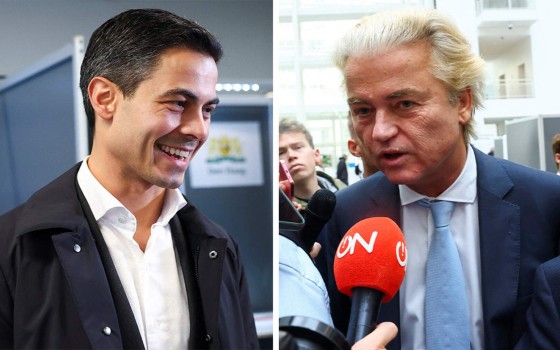
A direct attack on the gains of the working class and those with limited incomes, and the potential for continued rise in extremism within Dutch society... all these concerns stem from the minority government's program.
- Europe and Arabs
- Sunday , 8 February 2026 6:35 AM GMT
The Hague – Noureddine Amrani
How is the government agreement viewed? What is the future of their government program in the face of the challenges posed by the national and international arenas? And what awaits the Dutch people, especially citizens in a fragile economic and social situation? These are questions that demand attention, indeed, questions that must be raised to understand and unravel the threads of the political game in which three parties have played a role, defining the socio-economic framework for the next phase after managing to form the current minority coalition.
The government agreement presented on Friday by the Democrats 66 (D66), the Christian Democratic Appeal (CDA), and the People's Party for Freedom and Democracy (VVD) represents a direct attack on the gains of the working class and those with limited incomes. It is built upon the path of the Party for Freedom (PVV) government, with its extreme populist leanings, without a clear left-wing response to Robin Jetten's first government, and in the absence of any popular mobilization. Especially from the labor movement, which will pave the way for the continued rise of extremism in Dutch society.
All observers of Dutch politics have confirmed that the People's Party for Freedom and Democracy (VVD) shaped the contours of the new government agreement and imposed its will against the Democratic and Christian Democratic parties. While it is true that the party managed to extract important points from the agreement between the Democrats 66 and the Christian Democratic Appeal, such as reducing mortgage interest relief and introducing a "pay-as-you-go" system, this goes beyond the harsh neoliberal character of the Democrats 66 themselves. The process of undermining social security has a long history with the Democrats 66 in particular, and as Jejen demonstrated from the beginning of the election campaign, the inhumane policies towards refugees would also be in safe hands with him.
The government agreement is primarily an attack on the interests of workers and the economically and socially marginalized. After the Freedom Party government reduced the duration of unemployment benefits (WW) from two years to one and a half years, the first Yeten government wants to reduce them to just one year. In addition, the government also wants to cut the Work Disability Act (WIA), first by eliminating full disability benefits for newly diagnosed sick individuals. This is a double whammy for employers: they pay less in insurance premiums because people are more likely to access state-funded social assistance, and citizens are forced to accept jobs earlier, which comes at the expense of work quality, wages, and job security.
The compensation for transferring to the sector will be undermined. Companies are no longer obligated to pay compensation if a worker is dismissed after two years of illness. The government wants to "modernize" collective bargaining agreements (CAOs) and give companies operating in "new and innovative sectors" greater opportunities to evade them. "Privatization" in CAOs undermines their collective nature and increases competition among workers. Therefore, the government wants to raise the retirement age to seventy starting in 2030. This would mean reneging on the previous government agreement regarding the retirement age and undermining the agreement signed with labor unions with flimsy justifications in language that can only be described as neoliberal, imposing the logic of "lifelong learning" and the "need to activate the workforce." This vision aims to achieve further exploitation of workers and weaken the purchasing power of citizens in difficult situations.
Companies are no longer obligated to pay compensation if a worker is dismissed after two years of illness. Although healthcare costs as a percentage of GDP have remained stable for years, the government perceives a crisis. Therefore, it will halve the co-payment reduction scheme (Eigen Risico) and increase it to €460 annually by 2028. This is the largest item in the €8 billion annual healthcare cuts, which will be paid directly by workers and social security beneficiaries out of pocket.
As for housing, once a public service, construction companies will gain greater freedom to pursue quick profits without oversight.
Cooperative housing companies will be stifled, potentially leading to the elimination of social housing, a fundamental right, after the new government announced the possibility of reducing or even refusing to allocate further funds for housing guarantees. The government is attempting to justify cuts in public services by citing increased military spending. However, the planned budget deficit remains at 2.1%, within European limits. Meanwhile, the number of millionaires in the Netherlands rose last year, and corporations still hold a €162.5 billion debt to the national treasury, while workers are expected to pay an additional €3.4 billion in taxes annually. The first Jeten government is placing the burden of military spending on workers, not businesses or the wealthy.
Cuts in healthcare are necessary to allow for investment in the military. The government wants to legally enshrine Trump's 3.5% of GDP standard for military spending. The military budget is expected to nearly triple to 122,000 personnel, initially on a voluntary basis. If this fails, more mandatory measures will be implemented. Furthermore, the government is banking on strengthening the European arms industry. While Amnesty International campaigns for the right to demonstrate, which is under pressure, the first Yeten government chooses to continue to undermine and diminish this right by using force in "countering demonstrations," giving municipalities more powers to suppress demonstrations, and arming rapid intervention forces and police units.
Furthermore, Rob Peeten's government will continue to tighten restrictions on refugees, following the vision of the far-right Faber party, led by populist Geert Wilders, to reinstate the dual status system. This system allows for the deportation of war refugees as quickly as possible, meaning expediting the processing of asylum applications in the Netherlands. The new government, after taking office, will likely adopt a more pragmatic approach by refusing to accept migrants and expanding prisons to facilitate direct deportations from their countries of origin.
In higher education, Peeten's first government appears poised to abolish the reductions and the mandatory language test to ensure the alignment of study programs.
Regarding foreign relations, the government refuses to take any action against the State of Israel. Symbolic measures against certain figures within the Israeli regime will remain in place, but the government rules out any boycotts, divestment, or sanctions. The government will maintain imports of products from the territories occupied since 1967, and this will continue. On the other hand, the new government has expressed its support for a two-state solution, but it refuses to condemn Israel's actions in the West Bank and Gaza Strip.
The first Jetten government pledges to be right-wing, but in practice, it is likely to be even more right-wing. The three parties do not hold a political majority in either the House of Representatives or the House of Councillors, forcing them to rely on far-right parties such as JA21, the Political Reform Party (SGP), and the Citizens' Farmers Party (BBB) to pass proposals for a program that can only be described as crushing the hopes of the most vulnerable segments of Dutch society.
The Labour Party and its Green Left allies have declared their readiness to support the Rob Jetten government if it changes course radically. The party leader, Gies Klaver, stated, "I won't mince words; we can never support cuts," adding that his party rejects all harsh measures that negatively impact health insurance and social benefits. Finally, will this government, despite its minority status, be able to implement its program? Will it rely on right-wing and extremist parties to ensure its survival? Or will it try to gain the approval of other parties, especially since the latter expressed, during the marathon discussions in the Dutch parliament regarding the government agreement, that they are not prepared to endorse decisions that will harm the Dutch people? These are questions that will be answered by the coming days or months.








No Comments Found