

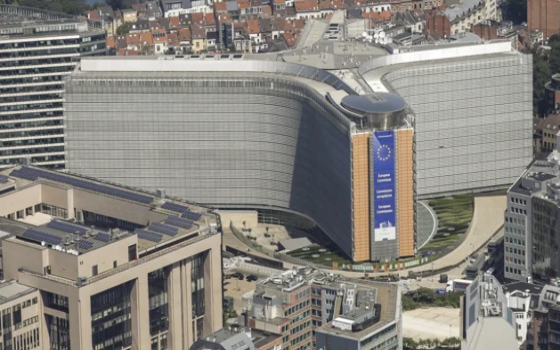
Despite a decline in company registrations and an increase in bankruptcies, the European economy continues to grow, with a slight rise in emissions and an increase in the share of renewable energy sources in electricity production.

- Europe and Arabs
- Friday , 21 August 2026 5:42 AM GMT
Brussels: Europe and the Arabs
The EU economy continues to grow, with a slight increase in emissions and a rise in the share of renewable energy sources in electricity production. According to Eurostat, the European statistical office in Brussels, the EU economy continued to expand, with GDP growing at a slightly faster pace than in 2025. Meanwhile, the latest data on per capita greenhouse gas emissions shows a slight quarter-on-quarter increase, along with a decrease in air pollutant concentrations in EU capitals. Monthly electricity consumption declined, in line with its usual seasonal pattern, and the share of electricity generated from renewable sources increased.
Economic sentiment improved, driven by increased confidence in all sectors except construction. Looking at monthly business indicators, industrial and service production expanded, while retail trade declined slightly.
In the second quarter of 2026, company registrations in the EU fell by 0.5% compared to the first quarter of 2026, while bankruptcies rose by 5.7%. This information is drawn from Eurostat data on company registrations and insolvency proceedings. Registrations fell by 3.6% in the industrial sector.
In the second quarter of 2026, company registrations declined in five out of eight economic sectors. The industrial sector recorded the largest decrease (-3.6%), followed by accommodation and food services (-3.4%), and then education and social services (-3.2%). In contrast, the number of company registrations increased significantly in the information and communication sector (+8.8%), and also rose in the construction sector (+1.0%), while the financial services sector remained unchanged (+0.0%).
Insolvency proceedings rose by 21.1% in the education and social activities sector.
Insolvency proceedings increased in five out of eight sectors. The largest increases were recorded in the education and social activities sector (+21.1%), the transport sector (+11.4%), and the financial services sector (+6.8%). In contrast, bankruptcies decreased in the accommodation and food services (-2.6%), construction (-1.7%), and trade (-1.2%) sectors.





No Comments Found