
Following a General Assembly resolution calling for an immediate humanitarian truce in Gaza.. United Nations. Collective punishment and hostage-taking are war crimes.

New York: Europe and the Arabs
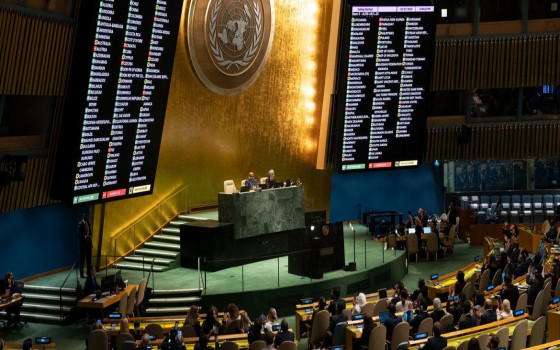
The United Nations Human Rights Office called for an immediate end to the collective punishment imposed by Israel on all residents of Gaza, an end to the indiscriminate attacks launched by Palestinian armed groups on Israel, and the immediate and unconditional release of all hostages. By a majority of 120 members, the United Nations General Assembly adopted a resolution calling for an immediate, permanent and sustainable humanitarian truce that leads to the cessation of hostilities and the immediate and unhindered provision of basic goods and services to civilians throughout Gaza.
This came within the framework of the tenth emergency special session of the General Assembly, entitled: “Illegal Israeli actions in occupied East Jerusalem and the rest of the occupied Palestinian territory.”
The resolution, submitted by Jordan on behalf of the Arab Group and a number of other countries, was opposed by 14 members, while 45 abstained from voting.
At the beginning of the resumption of the session meeting yesterday afternoon, Friday, Mahmoud Al-Hamoud, Permanent Representative of Jordan to the United Nations, reviewed the draft resolution. He asked to vote first on an amendment submitted by Canada to the project, expressing his opposition to the amendment.
The Canadian amendment stipulates “unambiguously rejecting and condemning the terrorist attacks launched by Hamas in Israel as of October 7, and the taking of hostages.” The amendment failed to obtain the specified majority of two-thirds of the number of votes.
the decision
The resolution adopted by the General Assembly on Friday calls for “an immediate, permanent and sustainable humanitarian truce leading to the cessation of hostilities.” It calls on all parties to comply immediately and fully with their obligations under international law, and to enable and facilitate humanitarian access to essential supplies and services to all civilians in need in the Gaza Strip.
The resolution bears the title: Protecting civilians and adhering to legal and humanitarian obligations. He strongly rejects "any attempts to forcibly transfer the Palestinian civilian population."
It calls for the cancellation of the order issued by Israel to Palestinian civilians and United Nations employees, as well as humanitarian and medical personnel, to evacuate all areas north of the Gaza Valley and move to the south of the Strip.
It also calls for the “immediate and unconditional release” of all unlawfully detained civilians, and demands their safety, well-being and humane treatment in compliance with international law.
It stresses the need to urgently establish a mechanism to ensure the protection of the Palestinian civilian population, and another humanitarian notification mechanism to ensure the protection of United Nations and all humanitarian facilities, and to ensure the unhindered movement of aid convoys.
The resolution condemns all acts of violence targeting Palestinian and Israeli civilians, including “all acts of terrorism and indiscriminate attacks, as well as all acts of provocation, incitement and destruction.”
In it, the General Assembly expresses deep concern about the catastrophic humanitarian situation in the Gaza Strip and its enormous repercussions on the civilian population, most of whom are children.
Interventions in the morning session before voting
Qatar
In the morning session before the vote, Qatar's permanent representative to the United Nations, Alia Ahmed bin Saif Al Thani, expressed her country's deep regret "for the failure of the Security Council to carry out its legal and moral responsibilities" as well as the failure to adopt any way out to establish an immediate ceasefire or adopt a binding resolution regarding... The deteriorating humanitarian situation in the Gaza Strip.
She stressed the importance of the General Assembly today carrying out its responsibilities in maintaining international peace and security. The Qatari Ambassador renewed her country's call to all parties to reduce the escalation to reach a complete ceasefire, "and the immediate release of all prisoners, especially civilians," and to ensure the arrival of urgent humanitarian aid to the Gaza Strip and open safe corridors that allow the entry of relief.
She renewed her country's condemnation of all forms of targeting civilians, especially women and children, and its categorical rejection of "the comprehensive siege imposed by Israel, the occupying power, on the Gaza Strip."
The Qatari ambassador reiterated her country's rejection of "the policy of collective punishment and attempts to forcibly displace the brotherly Palestinian people from the Gaza Strip."
In his country’s speech before the General Assembly, Egypt’s Permanent Representative to the United Nations, Osama Abdel Khaleq, said that failure to stop this war before it is too late “would drag the region into a devastating regional war that would affect the interests of countries that are reluctant to demand its cessation.” He stressed that it is self-evident when The outbreak of escalation and conflict requires that the United Nations system work to establish a ceasefire, adding that this is “not taking sides or supporting terrorism,” but rather it is to spare innocent blood, prevent further escalation, and confirm the ability of the United Nations to carry out its role in preserving the most basic human right. It is the right to life.
Abdel Khaleq stressed that “silence is no longer an option,” calling on the General Assembly to send a clear and unambiguous message, which is the need for the necessary needs of water, food and medicine to reach the Gaza Strip without restrictions or conditions, “as the deprivation of humanitarian aid under these circumstances is what is Except a death sentence for the people of Gaza.” He also expressed his “categorical rejection” of any attempt to displace the Palestinian people within their territories or to neighboring countries, adding that these attempts “must be confronted with all determination.” “The death, destruction, and despair occurring before our eyes is enough to make one lose faith in humanity,” said Linda Thomas-Greenfield, the US ambassador to the United Nations.
She said that Hamas' goals are "single-minded and disgusting" because it is determined to destroy Israel and "kill Jews," adding that the movement's use of Palestinian civilians as "human shields" is a "despicable and cowardly" act.
The American ambassador said that her country mourns the loss of every innocent life in this crisis, stressing the need "not to become numb to the pain and suffering of people like Wael Al-Dahdouh, the Palestinian journalist whose wife, son, daughter, and grandson were killed in Gaza this week."

She stressed that while Israel exercises “its right and responsibility to defend its people against the terrorist group, it must do so in accordance with the rules of war.” Greenfield said that the "brutal terrorist acts" committed by Hamas cannot be justified
As for Ambassador Abdulaziz Al-Wasel, the Permanent Representative of the Kingdom of Saudi Arabia to the United Nations, he called on member states to support and sponsor the draft resolution, which he said was conducive to international peace and security.
  He said that the current crisis is the result of the international community's failure to end the occupation and implement the two-state solution.
He added: "Silence over illegal Israeli practices - whether over the past seventy years or during the recent period - is what brought the region to the current crisis."
Turkey's Permanent Representative to the United Nations, Sedat Onal, said that this conflict should be prevented "from getting out of control and spreading to other regions," stressing the urgent need for "an immediate and unconditional ceasefire."
He added in his country's speech before the General Assembly that nothing justifies indiscriminate attacks against civilians and civilian infrastructure, stressing that "acts of collective punishment and attempts to force the displacement of people are unacceptable, and must stop."
In the same context, the United Nations Human Rights Office called for an immediate end to the collective punishment imposed by Israel on all residents of Gaza, an end to the indiscriminate attacks launched by Palestinian armed groups on Israel, and the immediate and unconditional release of all hostages.

The United Nations High Commissioner for Human Rights appealed to all parties to respond to calls for peace, stressing the need to end the violence.

At a press conference in Geneva, Ravina Shamdasani, spokeswoman for the United Nations Human Rights Office, said: “For nearly three weeks, Palestinian civilians in Gaza have been suffering from constant bombardment from Israel by air, land and sea. We are receiving horrific testimonies of entire families killed in air strikes on "Her homes, including the families of our employees, and parents writing their children's names on their arms to identify their remains (if they were killed)."
Shamdasani expressed sadness at the killing of more than fifty colleagues working with the United Nations and many other civilians who were clearly and disproportionately affected.
The spokeswoman indicated that despite repeated orders from the Israeli forces to residents of northern Gaza to move to the south, suggesting that the area there is safe, raids have intensified on two southern governorates and central Gaza in recent days. Violent bombardment continues on northern population centers, including Gaza City, she said.
She stressed that there is no safe place in Gaza. She said that forcing people to evacuate in these circumstances, including to places designated by Israel in the Al-Mawasi area and under the complete siege, raises serious concerns about forced transfer, which is a war crime.
It stated that Israel's use of explosive weapons with wide-ranging effects in densely populated areas causes massive damage to civilian infrastructure and loss of civilian lives, which is difficult to reconcile with international humanitarian law.
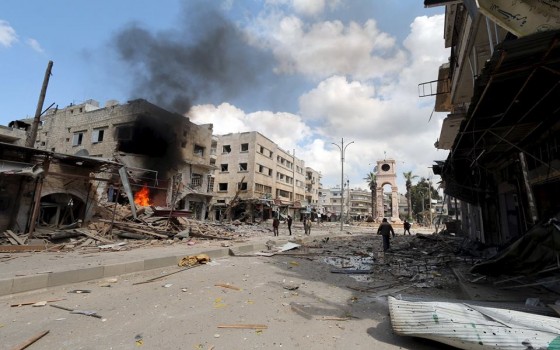
She said that collective punishment occurs through cutting off water, food, fuel and electricity supplies. She added: “A humanitarian catastrophe is unfolding for the 2.2 million people imprisoned inside Gaza who are being punished collectively.”
She also stressed the need to release all hostages held in Gaza immediately and unconditionally, and said that taking hostages is a war crime.
It conveyed the appeal of the High Commissioner for Human Rights to make efforts to find permanent paths based on human rights to achieve peace for the peoples of Palestine and Israel, and to make efforts to put an immediate end to this escalation.

Share

Related News

Comments

No Comments Found