
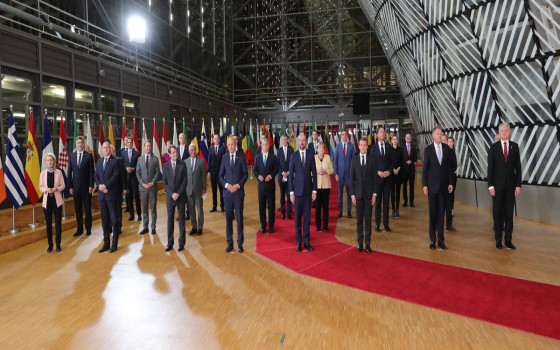
The closing statement of the European Union leaders summit, which concluded Friday in Brussels
- Europe and Arabs
- Friday , 21 October 2022 21:13 PM GMT
Brussels: Europe and the Arabs
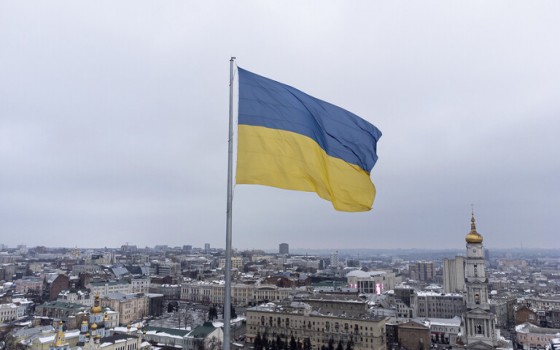
The final statement of the Brussels summit, which was attended by the leaders of the member states of the Union, said that the European Council dealt with Russia's escalation of aggressive war against Ukraine, which endangers peace and security in Europe and the world. The European Council is determined to confront disinformation aimed at nullifying our collective efforts to defend Ukraine's sovereignty and the rules-based international order.
We repeat that Russia bears sole responsibility for the current energy and economic crises.
The European Council condemns in the strongest possible terms the Russian missile and drone attacks, which launched indiscriminate attacks against civilians and infrastructure in Kyiv and across Ukraine.
It also condemns Russia's actions at Ukraine's Zaporizhzhya "nuclear power plant" and the leaders affirm the European Union's support for the efforts of the Atomic Energy Organization to maintain the safety, security and safeguards of the facility.
Recalling the statement of September 30, 2022, and in line with the UN General Assembly resolution of October 12, 2022, the European Council reiterated its unequivocal condemnation and unequivocal rejection of Russia's illegal annexation of the Ukrainian city of Donetsk, Luhansk, Zaporizhzhya and Kherson regions. As in the case of the European Crimea and Sevastopol, the Union will never recognize this illegal annexation.
Russia's unilateral decisions are deliberate, violate the UN Charter, and flagrantly ignore the rules-based international order. Russia does not have a legal basis for any action on the territory of Ukraine.
. The European Council reaffirms its full support for the independence, sovereignty and territorial integrity of Ukraine. According to the Charter of the United Nations and international law,
Ukraine has the right to exercise its natural right of self-defense against Russian aggression. It has the right to liberate and restore full control over all occupied territories within its internationally recognized borders.
. The European Council demands that Russia immediately, completely and unconditionally withdraw all its military forces from the entire territory of Ukraine within its international borders, as demanded by the United Nations General Assembly, and that Russia stop all forms of attacks against Ukraine.
War crimes against Ukrainians, of which evidence is mounting, and the ongoing destruction of civilian infrastructure are a flagrant violation of international law. The European Union reiterates its firm commitment to the need to hold all perpetrators and accomplices accountable, and its strong support for the investigations by the Prosecutor of the International Criminal Court.
The European Council recognizes Ukraine's efforts to achieve security and accountability, including the crime of aggression against Ukraine. EU leaders are calling on the High Representative for Foreign Policy and the Commission to explore options so that full accountability can be assured.
. The European Union has further strengthened its restrictive measures against Russia and is ready to continue to do so. The European Council stresses the importance of ensuring effective implementation and preventing and facilitating fraud and calls on all countries to comply with EU sanctions. Efforts should be intensified in this regard.
The European Council discussed how to increase collective pressure on Russia to end this aggression. The European Council stresses the importance of EU standard practices on visa issuance for Russian applicants, and welcomes the updated European Commission Guidelines. The EU will stand by Ukraine for as long as there is a need. It will continue to provide robust political, military and financial support to Ukraine, including its liquidity needs, and intensify its humanitarian response, particularly for winter preparedness.
The decision to establish an EU Military Assistance Mission to support Ukraine was adopted by the Council, as well as the recent decision to increase the European Peace Facility Assistance Measures to support the Ukrainian armed forces. The European Council commends the field work of the European Union civilian advisory mission in Ukraine. The European Council calls for the timely provision of the remaining €3 billion in total financial assistance to Ukraine. He calls on the Commission to provide it, and to work on a more structural solution to provide assistance to Ukraine. and the full potential of the Partnership Agreement and the Deep and Comprehensive Free Trade Agreement with facilitating their access to the single market.
The European Union is determined to support Ukraine's relief, rehabilitation and reconstruction, together with international partners and financial institutions. What happened at the International Experts Conference in Berlin on October 25, 2022,
The European Council called on the Commission to offer options in line with EU and international law with a view to using frozen assets to support
Reconstruction of Ukraine. Ukraine declared its readiness to achieve a just peace, which should include respect for its territory and sovereignty as protected by the Charter of the United Nations; Ukraine's ability to defend itself in the future must be protected; Ensure its recovery and reconstruction, including exploration
ways to do this with money from Russia; and pursue accountability for Russian crimes committed during the war.
The Council of Europe calls on the Belarusian authorities to stop enabling the Russian war and aggression by allowing the Russian armed forces to use Belarusian territory and by providing support to the Russian army. The Belarusian system must fully comply with its obligations under international law. The EU remains ready to move quickly with more sanctions against Belarus.
. The European Council strongly condemns the military support for Russia's war on the part of the Iranian authorities and it must stop. In this regard, the European
The Council welcomes the EU sanctions adopted on 20 October 2022.
food security
. Russia, through its war against Ukraine, is solely responsible for the food security crisis that it provoked. The Russian war of aggression caused disruptions in agricultural production, supply chains and trade, which pushed the prices of food and fertilizers in the world to unprecedented levels. But the tracks of solidarity between the EU and Ukraine made it possible to export large quantities of Ukrainian crops, agricultural products and fertilizers to
countries most in need. The EU will continue to improve the efficiency of all solidarity channels. The European Council supports the UN Secretary-General's call to extend the UN Black Sea Grain Initiative beyond its current term, which ends in November. EU sanctions against Russia do not prohibit the export of agricultural or food products between Third World countries and Russia. The European Council strongly condemns acts of sabotage targeting critical infrastructure, such as those against Nord Stream pipelines. The European Union will deal with any deliberate disruption of critical or other infrastructure through unified joint procedures and a firm response. The European Council calls on Member States to take urgent and effective measures, and to cooperate with each other, the Commission and other relevant actors, with a view to enhancing the resilience of critical infrastructure. Work must be taken
Fast forward a proposal to recommend the Council on a coordinated approach by the Union to enhance the resilience of critical infrastructure, including early
Implementation of the revised guidance on network and information systems security and the guidance on resiliency for critical entities.



No Comments Found