
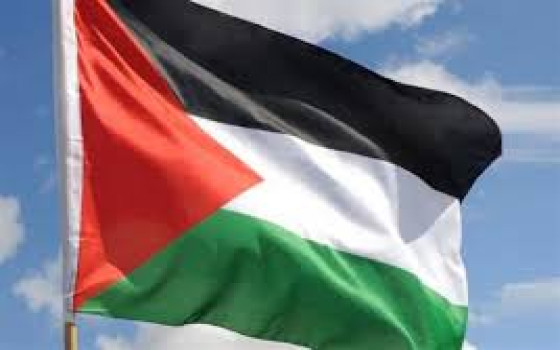
Russia's delegate to the United Nations: Israel's use of force in Palestine made 2022 the "bloodiest" and al-Maliki says: There is no real peace partner to negotiate with
- Europe and Arabs
- Tuesday , 29 November 2022 17:52 PM GMT
Brussels: Europe and the Arabs - Agencies
Russia's deputy representative to the United Nations, Dmitry Polyansky, announced that Israel's use of force in Palestine has killed about 130 people this year, making it the bloodiest year since 2005.
"According to the information received, the use of force by the Israeli authorities in the West Bank during the current year resulted in the killing of more than 130 people, which makes it the year with the most bloody nearly two decades ago.
He added that the actions of the Israeli authorities, including the construction of settlements and the confiscation of Palestinian property, as well as the use of violence, have resulted in effects that are difficult to remove.
For his part, the United Nations Special Coordinator for the Middle East Peace Process, Tor Winsland, said, "The international community pays less attention to the Palestinian cause because of the crisis in Ukraine and other global developments, which has exacerbated the suffering of the Palestinians."
He warned of the danger of continuing Israeli violence in the Palestinian territories and targeting civilians, stressing that targeting civilians cannot be justified at all, and the violence must stop.
He explained that the Security Council session came in light of the escalation of violence in the occupied Palestinian territories, and in the context of a stalled peace process and entrenched occupation, and amid increasing economic and institutional challenges facing the Palestinian Authority, stressing the need for political leadership to restore the path towards the two-state solution.
He added, "The required steps are: first, we must continue to engage with the parties to reduce tensions and confront negative trends, especially those affecting final status issues, and second, we must continue to improve access, movement, and trade to allow room for the growth of the Palestinian economy, in addition to reconnecting the economies of the West Bank." and the Gaza Strip, and third, the need for efforts by all parties and the international community to strengthen Palestinian institutions, improve governance, and strengthen the financial health of the Palestinian Authority.
The Palestinian Minister of Foreign Affairs and Expatriates, Riyad Al-Malki, confirmed that there is a dilemma facing the Palestinian Authority, which is that there is no real peace partner in Israel to negotiate with.
This came during Minister Malki's meeting with a number of foreign ambassadors accredited to the State of Palestine who are not residents at the headquarters of the Embassy of the State of Palestine in Cairo, in the presence of the Assistant Minister for Arab Affairs, Fayez Abu Al-Rub, the Assistant Minister for Economic and Financial Affairs, Mustafa Al-Barghouti, and the Ambassador of the State of Palestine to Egypt and its permanent delegate to the Arab League, Diab Al-Louh. And a number of advisers to the embassy and the Palestinian delegation to the Arab League.
Al-Maliki said, "A new Israeli government is currently being formed, and this government will be different from all previous governments in the sense that it will be a government that is more hateful and hateful to the Palestinians to the greatest degree, as it will contain elements known for extremism and extremism, and will allow settlers' violations of Al-Aqsa Mosque, which means" we We will move from a political crisis to a crisis of a religious nature, and if that battle shifts from a political one to a religious one, we will not find a solution to it at all, and we will not accept that, because our battle with Israel is political par excellence.”
The Palestinian Minister of Foreign Affairs and Expatriates called for the need for all countries to recognize the State of Palestine, because there should not be a state that is hesitant until now. The rules of the game must be changed at this sensitive stage, and clear messages must be sent to Israel, including its refusal to sit down and negotiate with the Palestinians, and the necessity of moving the State of Palestine from a non-state. Observer member of the United Nations to become a full member state like all other countries because this is a right that the State of Palestine must obtain and the international community must provide this right.
Al-Maliki stressed the necessity of translating commitment to the two-state solution into action mechanisms, noting that the policy of "remaining silent" gives Israel approval to work to change the reality on the ground and impose new realities to prevent the establishment of a Palestinian state and its embodiment in the concept of the two-state solution. Unilateral measures must be immediately stopped. They violate international law and prevent the realization of the two-state solution, and international protection must be provided to the Palestinian people until the end of the occupation.
Al-Maliki stressed that it is necessary to think about imposing sanctions on Israel for violating international law and the necessity of imposing a new Security Council resolution, as it is not a state above the law. completely because previous decisions were unable to be translated.
He noted that today falls on November 29, which is the International Day of Solidarity with the Palestinian People, so that the whole world shows extraordinary interest in the Palestinian cause, and meetings and seminars are held on the issue in order to remind the world that the tragedy of the Palestinian people is still going on and there is a need to give greater attention and focus to address this issue and reach a solution. permanent solution.
Al-Maliki affirmed, "Every time an Israeli government comes that ignores our rights, and works to expel us from our homeland and from our land, but we adhere to our existence and to the political solution through the negotiation process, and the question that arises now, after what we have seen of the measures and right-wing Israeli governments, is there a political partner on the Israeli side? We say For a long time, this partner has not existed, but until this moment we are committed to the two-state solution, to negotiation as a basis, and to renouncing violence, because we believe in the culture of peace, and our concept of the two-state solution is an independent, viable, sovereign, and geographically contiguous Palestinian state on the 1967 borders, with East Jerusalem as its capital.
The Minister of Foreign Affairs stressed that there are many challenges facing the Palestinian leadership, the most important of which is the transition of the situation from a short occupation to a long and sustainable occupation, in addition to the fact that we have 740,000 settlers living in more than 170 illegal and illegal settlements established on the land of Palestine in the West Bank, including East Jerusalem.
He added that the other challenge that we also face is that there is a country called the State of Palestine whose land is occupied and recognized by more than 145 countries that have more than 100 embassies in the world and it is a non-member state, with an observer status in the United Nations, and it is a founding member of the Arab League and a founding member of the non-violence movement. Alignment and a founding member of the Group of 77 + China, which Palestine chaired two years ago, and Palestine now lacks sovereignty, despite all UN resolutions.
In a related context, the United Nations is leading the humanitarian response and has helped put in place measures to support the Gaza economy, including improving the movement of people and goods to and from Gaza, in addition to vital projects, such as providing fuel for the Gaza power plant and cash assistance to more than 100,000 families, and will continue Until next year.
Source: Middle East News Agency



No Comments Found