
Positive developments in Yemen, and a call for a peaceful solution and the promotion of humanitarian action
- Europe and Arabs
- Thursday , 16 March 2023 16:54 PM GMT
Brussels: Europe and the Arabs
The UN Security Council listened to two briefings from UN officials on the situation in Yemen. The two officials touched on some positive developments on the ground, but stressed the need to do more to reach a comprehensive solution to the conflict, and to meet the needs of 17 million people in urgent need of assistance and protection. The truce brokered by the United Nations prior to the holy month of Ramadan last year, and he said that Yemen is still benefiting from the achievements of the truce, but he said that Yemenis hope to achieve more than that, which is to find a way to move forward towards a comprehensive solution to the conflict.
The UN envoy touched on the relatively stable military situation since the truce entered into force, but he expressed concern about the escalation and intensity of the clashes on several fronts, especially Marib and Taiz.
He called on the parties to exercise maximum restraint during this critical period, including avoiding escalatory rhetoric to prevent the situation from being destabilized.
Diplomatic momentum and a difficult economic situation
Grundberg said that daily life remains difficult for most Yemenis, the economic situation remains dire, and "the familiar and unfortunate pattern of economic victimization, rather than cooperation, persists."
"With the relative stability of the security situation, but in the absence of agreement on the way forward, it may seem that Yemen has become stuck in a shaky political pattern, but vigorous diplomatic efforts are being made at various levels to end the conflict in Yemen," the UN envoy added.
He talked about the diplomatic momentum at the present time at the regional level, welcoming the tireless efforts of the countries of the region, especially the Kingdom of Saudi Arabia and the Sultanate of Oman.
He called on the parties to seize the opportunity, maintain a constructive environment for discussions, and allow the necessary time and space for the talks to bear fruit.
Efforts for a permanent settlement
Grundberg said that short-term solutions and a partial approach can only provide a partial breakthrough, as a cease-fire and a sustainable political settlement can only be achieved through a more comprehensive approach.
He stressed that he continues to work tirelessly with the Yemeni parties and regional and international stakeholders to achieve this goal.
The UN envoy before the Security Council welcomed, through a closed communication circle, the recent efforts made by the Yemeni government to prepare for the political process through the work of the Consultation and Reconciliation Committee. He affirmed his willingness to work with the Yemeni parties and support them to engage in the political process.
He stressed the need for a political process that addresses the concerns and aspirations of the Yemeni people to be inclusive and Yemeni-owned, and to include the voices of a wide range of Yemeni stakeholders including youth, civil society and women.
He said that last week's celebration of International Women's Day reminds us of the role women play in promoting peace, and also of the constant risks and constraints women face.
He affirmed his commitment to promoting the meaningful participation of women in all aspects of the peace process in line with the agenda of women, peace and security in Security Council Resolution No. 1325 and other relevant resolutions.
Grundberg touched on the meeting of the supervisory committee for the implementation of the prisoner exchange agreement, which he co-chairs with the International Committee of the Red Cross. He said deliberations were still taking place between the parties, and called on them to continue engaging in good faith.
regional momentum
Regarding his efforts to achieve peace, the UN envoy renewed his appreciation for the unity of the Security Council and its firm support, referring to his recent visits to Moscow, Abu Dhabi, Paris, Tehran and Riyadh.
The envoy welcomed the recent agreement between Saudi Arabia and Iran to resume diplomatic relations with China's facilitation. He said that dialogue and good neighborly relations are important for the region and Yemen.
He stressed the need for the parties to seize the opportunity presented by this regional and international momentum in order to take decisive steps towards a more peaceful future. He said that this requires patience, foresight, courage and leadership.
The number of hungry people decreased
Joyce Msuya, Assistant Secretary-General for Humanitarian Affairs, began briefing her with positive news, as she indicated that the number of hungry people in Yemen had decreased by two million, and that the food insecurity assessment index had decreased from the fifth degree, which is the highest, to zero. She said this was largely thanks to the relentless efforts of aid workers, the generous support of donors, and the truce.
I also talked about progress on the giant Safer oil reservoir, as the United Nations Development Program announced the purchase of a replacement oil tanker, which is scheduled to arrive in Hodeidah in May.
This step comes as part of the process coordinated by the United Nations to avert a catastrophic oil spill from the dilapidated tanker Safer, which threatens a humanitarian and environmental crisis. The United Nations confirmed the urgent need for funding to complete the safe removal of oil from the Safer tanker.
But with the positive news, the UN official stressed that Yemen remains a massive emergency, as "more than 17 million people depend on aid and protection from aid agencies. But agencies often do not have what they need to provide assistance."
She pointed to challenges related to access, security, financing, and economic problems driving more people into destitution.
Reach out to those in need
In terms of access and security, Msoya said the agencies are more present in areas that have been difficult to access due to fighting and restrictions imposed by the UN's internal security authorities and rules.
In recent weeks, agencies have reached former frontline areas in Hodeidah, and remote parts of Hajjah hosting a huge number of displaced people, in addition to other locations that were difficult to reach.
These efforts come, as the UN official said, within the framework of the commitment to transfer relief operations, as far as possible, outside the main centers to be closer to the needs of people wherever they are. It stated that the Houthi authorities had recently accelerated the issuance of approvals for relief projects in areas under their control.
Despite these positive developments, the overall picture regarding access and security is very bleak, according to the Deputy UN Emergency Relief Coordinator.
“In Houthi-controlled areas, Yemeni female aid workers are still unable to travel without the guardianship of a male (mahram), in and out of Yemen. This seriously impedes agencies’ ability to safely and reliably assist women and girls.”
It called on the Houthi authorities to lift such restrictions on movement and to work with relief agencies to find an acceptable way forward.
It noted the continued detention of two UN staff members in Sana'a after the Houthi authorities arrested them in November 2021. Msoya called for their immediate release.
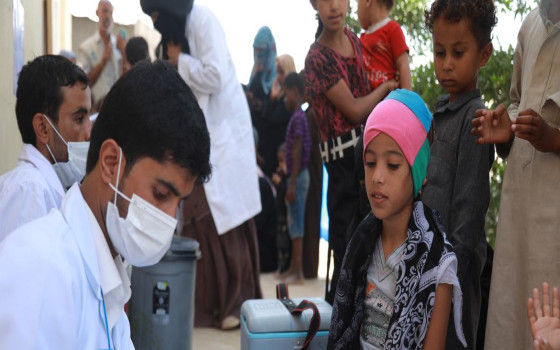
Humanitarian agencies are also concerned about growing skepticism towards vaccines, especially in Houthi-controlled areas, leading to an increase in the spread of preventable diseases such as measles and polio.
In addition to these challenges, insecurity continues in many areas, threatening aid workers and impeding access to some areas, especially in Shabwa and Abyan. The UN official called for the immediate release of five UN employees who were kidnapped in Abyan more than a year ago.
financing
Two weeks ago, the Secretary-General of the United Nations participated in the governments of Sweden and Switzerland in holding the seventh annual conference to announce pledges to Yemen. More than 30 donors have pledged $1.16 billion for humanitarian work.
Joyce Msuya, Assistant Secretary-General for Humanitarian Affairs, considered the outcome of the conference good in view of all the events in the world, but said that this is the least amount the conference has mobilized since 2017 and will not be sufficient to carry out relief operations until the end of the year.
The Yemen Humanitarian Response Plan had identified $4.3 billion to assist 17 million Yemenis.
Support the Yemeni economy
The UN official expressed grave concern about the need to provide more support to the Yemeni economy. She said the economic downturn is among the biggest factors in increasing humanitarian needs.
One of the agencies' priorities is to clear the landmines and other explosive devices that kill and maim so many and cripple economic life.
The United Nations is working with donors and partners to develop a revised economic framework to address the broader economic factors driving humanitarian needs in Yemen.
With the advent of the holy month of Ramadan, the UN official expressed the hope that everyone would look carefully at the situation in Yemen and how to provide assistance in this regard. This includes, she said, addressing the challenges she addressed in the briefing, and supporting the work being done to achieve what Yemen aspires to most of all: peace.





No Comments Found