
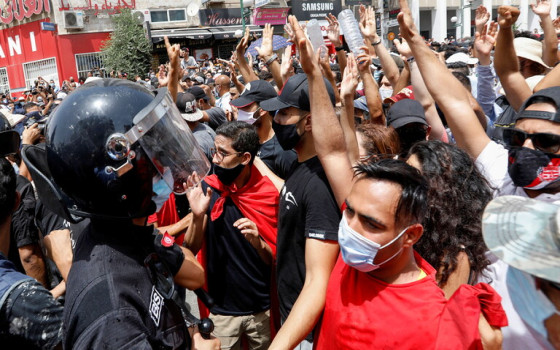
European Union: The Minister of Foreign Affairs of Belgium and her Portuguese counterpart to Tunisia to prepare a report on the situation in the country to determine future action
- Europe and Arabs
- Tuesday , 21 March 2023 16:8 PM GMT
Brussels: Europe and the Arabs
The European Union has asked Belgian Foreign Minister Hajja Lahbib, "of Algerian origin," and her Portuguese counterpart, Joao Gomez, to visit Tunisia, the Brussels Times reported.
Their visit comes amid growing concerns about the economic and political situation there, and a possible increase in the number of migrants coming to Europe as a result. According to what was reported by the Belgian news agency today, Tuesday
"The situation in Tunisia is very serious," EU foreign policy chief Josep Borrell told reporters on Monday after a meeting of EU ministers in Brussels. "If it collapses economically or socially, we will be in a difficult situation as new flows of immigrants will come to Europe."
Borrell said that Habib and Joao Gómez Cravinho were asked to "assess the situation and come back with a report that will guide our future steps."
According to the Belgian news agency, the multiple sources of concern in Tunisia include the ongoing economic crisis, which is characterized by inflation of 10.4 percent and unemployment of more than 15 percent. On the political level, the arrest of more than 20 opposition figures in recent weeks has been widely criticized, both in Tunisia and internationally.
There was also widespread criticism of the crackdown on migrants from sub-Saharan Africa after a speech by Tunisian President Kais Saied on February 21, which Amnesty International called "discriminatory and abhorrent". In his speech, he referred to the presence of black African immigrants in Tunisia as a "sub-Saharan occupation" linked to "attempts to change the demographic composition of Tunisia."
New constitution
The meeting of EU ministers coincided with the inauguration of a new Tunisian parliament with limited powers, the result of distorted elections held under a new constitution approved in a referendum on July 25, 2022. This came a year after Saied granted himself sweeping powers by suspending the old parliament. dissolution and dismissal of the government.
The new constitution established a hyper-presidential system. This reduced the powers of Parliament, which was the real center of power after the fall of former leader Zine El Abidine Ben Ali in the aftermath of the first Arab Spring revolution in 2011.
The new Assembly of the Representatives of the People, elected in December and January in rounds marked by 89 percent abstention, held its first meeting on Monday, broadcast live on public television, at its headquarters in Bardo, a city near Tunis. Only official Tunisian media was allowed to cover the meeting: representatives of the private press and foreign journalists were turned away, according to an AFP correspondent.
"The situation in Tunisia is very dangerous."
The new parliament has 161 members, but only 154 seats have been filled so far. She has only 25 women. After taking the oath, the deputies were to elect the speaker and two deputies.
The main opposition National Salvation Front coalition said in a statement that it does not recognize the new parliament "born from a coup constitution and elections rejected by the overwhelming majority of voters."
The conservative Islamist Ennahda Party - the main faction in the dissolved parliament in 2021 - also said in a statement that it had refused to recognize "a parliament devoid of any legitimacy".

No Comments Found