
Moroccan Minister: We have achieved success in linking water, energy and food security
- Europe and Arabs
- Sunday , 2 April 2023 13:42 PM GMT
Brussels: Europe and the Arabs
Like many Arab and African countries, the Western Kingdom suffers from the repercussions of climate change, which led to a decline in water imports in the Kingdom, which negatively affected the process of filling dams, but the Kingdom is making efforts to address the problem of water shortage through various means and strategies, according to Mr. Nizar Baraka, Minister of Equipment and Water In Morocco.
Mr. Nizar Baraka participated in the United Nations Water Conference, which was held recently in New York, with the aim of reviewing the challenges that his country is going through in the field of water and the achievements made by the Kingdom.
In an interview with UN News, the Moroccan minister touched on the strategy set by His Majesty King Mohammed VI to confront water problems and the repercussions of climate change on Morocco, noting that the Kingdom suffers from the problem of water stress, and the matter may develop into water scarcity with the acceleration of climate changes, as he put it.
The Moroccan minister said that he also reviewed his country's cooperation with several friendly countries in Africa as well as many Arab countries in order to work on sharing successful experiences and work on developing a common vision in this context.
Mr. Nizar Baraka said that his country has a strategy on water called the integrated management of water resources, and this experience has been launched since 1995. Its aim is to develop a long-term plan with regard to knowing the state of ground and surface water. As well as defining the strategies that should be followed in order to face the problems and work to ensure the need of citizens for citizens.
It also aims to draw up agreements on the integrated management of water basins and groundwater, thanks to which the share of each individual will be determined based on the water situation in order to have a future vision and ensure the sustainability of these groundwaters.
In his answer to a question about whether there is a specific aspect of the climate change phenomenon from which the Kingdom of Morocco suffers greatly?
Minister Nizar Baraka replied: The real suffering in Morocco is the problem of drought and extreme phenomena, including floods.
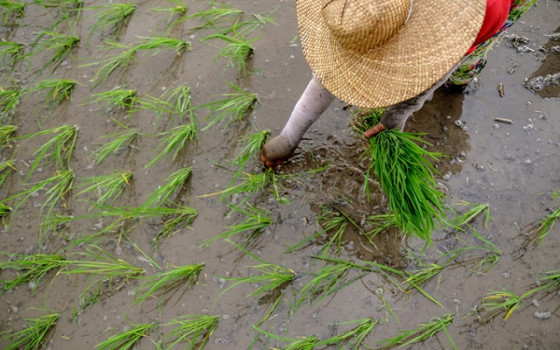
For example, last year we had one of the hottest years, with temperatures one degree higher than the annual average. There was a decline of more than 50 percent in water imports, and it was greatly reflected in the level of filling dams and in potable water. It was greatly reflected in the water used for irrigation, as the amount of this water decreased by two-thirds as a result of poor water capabilities during this year. Therefore, a new road map was developed focusing on three pillars:
First, continue to accelerate the pace of construction of large dams,
Secondly, working on water desalination and wastewater treatment in order to mobilize other potentials in the field of water.
Third, work on saving water and water efficiency by improving productivity and moving towards drip irrigation for agriculture and farming.
Finally, groundwater conservation.
All these pillars were set by His Majesty the King in his speech on the occasion of the opening of Parliament.
In response to a question about Do you have success stories in the field of water management?
Minister Nizar Baraka replied: I think that the biggest success story that can be presented is the interdependence between water, energy and food security. This interconnection has been achieved in the city of Dakhla, where water desalination plants will be installed thanks to wind and wind energy.
This will be done at a low cost of 30 cents per cubic meter of water, which will be used to provide potable water and for agriculture as well. Irrigation water will be provided for five thousand hectares destined for export and agriculture.
All of this is a great success because it will enable us to achieve this relationship between water, renewable energy and food security.
In response to a question: This conference is held 47 years after the last international water conference in Argentina. How do you see its importance in helping countries achieve their national water plans?
Minister Nizar Baraka said: This conference is a great opportunity - first - to work on setting a road map for the sixth goal of sustainable development related to ensuring the availability and sustainable management of water and sanitation for all.
Secondly, it also represents an opportunity to learn about the successes that have been achieved in this field and to share the experiences of successful people in this field.
Thirdly, it is also an opportunity for concerted efforts to solve the continental problems related to climate change, and we must all adhere to these goals and work jointly in order to confront them.
Finally, this conference is an opportunity to introduce our future visions, as well as the initiatives that have been launched in several fields, especially with regard to water, and to guarantee this basic human right, which is the right to water, for all citizens across the world.


No Comments Found