

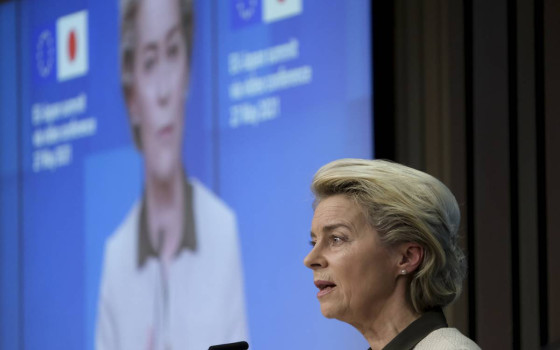
A debate session in the European Parliament on relations with China and prioritization in light of developments

- Europe and Arabs
- Sunday , 16 April 2023 17:5 PM GMT
Brussels: Europe and the Arabs
The European Commission in Brussels said that a plenary session of the European Parliament will take place the day after tomorrow, Tuesday, in Strasbourg, in which the President of the European Commission, Ursula von der Leyen, will speak about relations with China, especially in light of developments and developments, whether regional or international, in an attempt to determine the priorities of European action in this regard.
It is expected that the session will witness questions being asked by the deputies to the European official, who will present a report on the results of the recent visit to Beijing, accompanied by French President Emmanuel Macron. The political and commercial dispute between the two sides is renewed from time to time, and Brussels justifies this because of China's practices, whether in the field of investments, trade, or rapprochement with Russia and others at times when these parties face European sanctions.
According to media reports, the European Union has tried to reduce its problems and risks with China, and to reset the Europeans' policy towards Beijing, at a time when the unified bloc is going through economic and social crises in light of the continuing war in Ukraine.
The Spanish newspaper "Politica Exterior" said that diplomatic relations between the European Union and China appear to be somewhat more stable these days than they were almost last year.
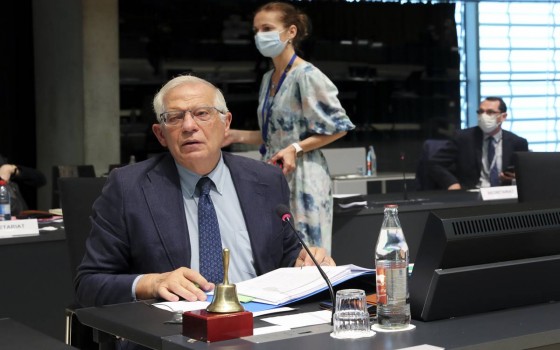
The newspaper pointed out that German Chancellor Olaf Schultz opened high-level exchanges with China and visited Beijing at the end of 2022, as did European Council President Charles Michel, in April, and it was the turn of French President Emmanuel Macron, European Commission President Ursula von der Leyen and High Representative Joseph Borrell.
Beijing has toned down its rhetoric towards the EU. Fu Cong, the new Chinese ambassador to the EU, fills in the year the position remained vacant, and he actively meets with key European interlocutors. Working dialogues are revived: even the EU-China dialogue on human rights is back. to emerge.
The newspaper monitored 6 priorities for restoring relations between the European Union and China, which are:
Recognizing and managing the strategic difference with China
Beijing's "charm" diplomatic offensive and economic reopening are certainly appealing to the EU, at a time when the Ukraine war and resulting energy crisis have hit the European economy hard, so the easing of tensions with China and the stabilization of economic relations is encouraging.
But the EU and China sanctions, as well as the lifting of the ban on the ratification process for the Comprehensive Agreement on Investment between the EU and China (CAI) - according to the newspaper, do not address the underlying tensions in relations, as China still aims primarily to prevent Europeans from joining the initiatives. It is not about a new cooperative commitment, but about maximizing room for maneuver in a deep strategic competition with the United States.
The newspaper pointed out that the differences over the war in Ukraine are still underestimated by many in China or accepted as a price for Moscow's support, which is a major driver of deepening the differences.
Implementation and expansion of the EU's defense tools
In recent years, the Europeans have made significant progress in developing a common assessment of the challenges posed by China and a common set of defense policy tools that, while not theoretically targeted at any particular country, focus on some of the main challenges related to China and include screening for foreign direct investment and anti-coercive mechanisms. and measures to address distortions of the single market as a result of subsidies from third countries.
Design a coordinated and independent approach to high technology
High-tech relations with China have become very controversial. The EU urgently needs to develop a specific approach to managing innovation and technology relations with China. After the United States' summer 2022 "ideological shift" on technology controls, which aims to undermine China's high-tech capabilities, Beijing has ramped up its ambitions for self-sufficiency in science and technology.
Reduce weaknesses in important raw materials
Europe's dependence on imports of Chinese raw materials overshadows its ability to benefit from the environmental transition. At present, China provides more than 90% of the rare earth elements needed by the European Union to develop green technology products. To solve this problem, the European Commission is about to propose a law on critical raw materials. It is expected to include a single purchasing agency that sets a target to extract, recycle and process between 10% and 40% of critical raw materials within the EU by 2030.
Prepare for conflict in Taiwan
The European Union needs contingency plans to manage a possible worsening conflict in Taiwan, the consequences of which will be much greater than the consequences of the war in Ukraine, as the cost to the global economy of such a conflict in the closure scenario is estimated at about $ 2 trillion in monetary terms alone, without counting the international responses and the effects collateral and other repercussions, and the geopolitical and humanitarian repercussions will be devastating.
Therefore, the main goal in risk reduction should be to consolidate the status quo in the Taiwan Strait and prevent conflict. The EU should consider a number of possible scenarios and develop a package of preventive and deterrent measures.



No Comments Found