

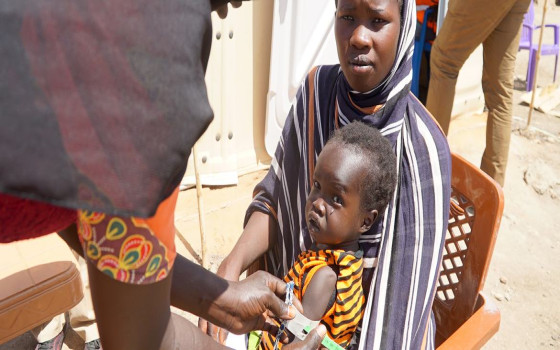
Intensifying international efforts to confront the humanitarian crisis in Sudan, after announcing that 40% of the population would suffer from hunger if the fighting continued.

- Europe and Arabs
- Thursday , 11 May 2023 16:14 PM GMT
New York - Khartoum: Europe and the Arabs
The United Nations and its partners continue to ramp up efforts to respond to the humanitarian crisis resulting from the fighting in Sudan.
UN Deputy Spokesperson Farhan Haq told the daily press conference that the World Food Program plans to expand emergency assistance to about 4.9 million people in the coming months in areas where the security situation allows.
And this came in the daily bulletin of the United Nations, of which we received a copy via e-mail, and according to what was stated in the bulletin, "The World Food Program aims to prevent and treat moderate acute malnutrition for about 600,000 children under the age of five, and pregnant and lactating women.
The program indicated that food insecurity is expected to rise to record levels in Sudan due to the conflict, as more than 19 million people are expected to be affected.
The United Nations Humanitarian Air Service - run by the World Food Program - is resuming regular flights between the cities of Port Sudan and Addis Ababa, to ensure the flow of essential aid and the arrival of humanitarian workers.
On the other hand, the United Nations Population Fund (UNFPA) warned that women and girls displaced by conflict are at increased risk of gender-based violence and sexual exploitation and abuse.
The UN fund reported limited access to prevention and response services in the capital, Khartoum, and throughout the country. This is due to the lack of fuel and supplies and the destruction and looting of health care centers and hospitals.
The Fund works with its humanitarian partners to create safe spaces for women and girls in countries hosting internally displaced persons.
It also helps expand remote services to support survivors of gender-based violence.
The need to support the community response
On a related note, Farhan Haq said that the Under-Secretary-General for Humanitarian Affairs, Martin Griffiths, spoke on the phone with first responders in Khartoum - including doctors and engineers.
During the call, Mr. Griffiths heard first-hand the community-led humanitarian response efforts, and the courageous efforts of local community members to provide food, shelter and emergency health support amid the constant threat of violence and looting, according to Mr. Haq.
Mr. Griffiths commended the resilience and creativity of the Sudanese people, emphasizing the need for their support.
This came as the World Food Program warned that the continuation of violence in Sudan will lead to an increase in the number of hungry people by between 2 and 2.5 million people, bringing acute food insecurity to record levels and affecting more than 19 million people, or about 40% of the population. .
The United Nations program expected that the largest increase in food insecurity would occur in the states of West Darfur, West Kordofan, Blue Nile, Red Sea and North Darfur.
In a press release, the program pointed to the high cost of food across the country, and expected an increase in basic food prices by 25 percent in the next three to six months.
He said prices could rise further if farmers are unable to access their fields and grow basic foodstuffs between May and July.
The fighting - which broke out between the army and the Rapid Support Forces on the fifteenth of April - has led to violence and insecurity, forcing the World Food Program to temporarily suspend its operations in Sudan, before resuming it again, reaching more than 35,000 since last week. person with essential food.
The United Nations Humanitarian Air Service - run by the World Food Program - will begin regular flights between Port Sudan and Addis Ababa in Ethiopia to facilitate the safe transportation of frontline humanitarian workers as well as vital aid.
The World Food Program will increase its emergency assistance to support 4.9 million people in need in areas where the security situation allows, in addition to preventing and treating moderate acute malnutrition for about 600,000 children under the age of five and pregnant and breastfeeding women.






No Comments Found