
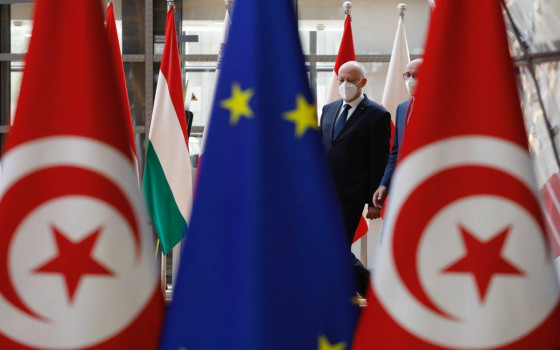
Brussels publishes the text of a memorandum of understanding on a strategic and comprehensive partnership between the European Union and Tunisia

- Europe and Arabs
- Monday , 17 July 2023 7:28 AM GMT
Brussels: Europe and the Arabs
European Commission President Ursula von der Leyen, Italian Prime Minister Giorgia Meloni, and Dutch Prime Minister Mark Rutte have agreed, in the spirit of the European team, together with the President of Tunisia, Kais Saied, to implement the announced comprehensive partnership package. which were jointly announced on 11 June 2023. In Tunisia, they witnessed the signing of the Memorandum of Understanding by the Commissioner for Neighborhood and Enlargement Oliver Varhelyi and the Minister of State to the Minister of Foreign Affairs, Migration and Tunisians Abroad, Mounir Benjiba, opening a new chapter in EU-Tunisia relations.
According to a European statement issued in Brussels, the memorandum of understanding covers five pillars: macroeconomic stability, trade and investment, green energy transition, people-to-people contacts, and immigration. It will be implemented through the various areas of cooperation between the EU and Tunisia, following the relevant regulations and established procedures.
The enhanced political dialogue within the EU-Tunisia Association Council before the end of the year will provide an important opportunity to revitalize political and institutional relations, with the aim of facing common international challenges together and preserving the rules-based order.
Given the historical relations that bind Tunisia and the European Union, the strategic nature of their partnership, and the challenges, and the aspiration of the two parties to raise their relations to a higher level by strengthening their economic and trade partnership, with the aim of supporting the economic reforms decided by Tunisia and necessary to restore macroeconomic balances; Also considering the importance of strengthening cooperation to combat and reduce irregular migration flows and saving human lives, and with reference to the high-level joint declaration issued on June 11, 2023, the two parties agreed on the following:
macroeconomic stability
The European Union is committed, in accordance with relevant regulations and decision-making practices, to assist Tunisia in its efforts to promote economic growth with the aim of creating a model of sustainable and inclusive development, through appropriate policies, including social and economic reforms. Designed by Tunis. The implementation of this approach will be discussed during the third quarter of 2023. The EU will support the reforms, in particular through budget support, the amount of which will be paid in full for 2023.
Economy and trade
The two parties seek to enhance their economic and commercial cooperation with the aim of developing trade in goods and services, creating an appropriate and attractive business climate, as well as investment and sustainable development. The two parties seek to implement measures to promote and strengthen the modernization of the framework of trade and investment relations between the European Union and Tunisia in order to improve the conditions for access to markets. They seek to identify opportunities for public investment, public-private partnerships and private enterprise, including within the framework of the European Fund for Sustainable Development (EFSD+), in the areas of competitiveness and private sector development, modernization of distribution circuits and market surveillance, access to finance, water and sustainable agriculture and technologies. Clean and / or within the framework of the circular economy, renewable energies, preparation for renewable hydrogen production and integration into strategic sectors of value chains in the European Union, in strategic sectors with high export potential.
green energy transition
Aware of Tunisia's potential in terms of renewable energies and in their common interest to ensure better security in terms of energy production and supply between the two parties, Tunisia and the European Union are working to conclude a strategic partnership in the field of energy, thus promoting green growth and job creation. This strategic partnership will help enhance the security of energy supply and provide citizens and businesses with low-carbon energy at competitive prices. It will also aim to strengthen the network infrastructure in Tunisia, including the smart grid. The two parties seek to enhance their cooperation with the aim of implementing Tunisia's commitments under the Paris Agreement, including its Nationally Determined Contribution (NDC) and its National Strategy for Carbon-Neutral and Climate-Resilient Development by 2050 in the areas of climate change mitigation and adaptation. . The two parties seek to promote the production of renewable hydrogen and its derivatives, including ammonia, in Tunisia, in a way that serves its local market and international demand, while taking into account the need to protect its water resources. The two parties intend to explore the possibility of enhancing cooperation in clean energy technology supply chains and power generation in a way that is mutually beneficial. The Parties agree that the objectives of the Strategic Energy Partnership require a large-scale mobilization of targeted financial instruments, including guarantees, accompanied by appropriate reforms leading to an enabling regulatory framework that is transparent, stable and predictable, to attract investments and develop trade in the renewable energy sector in Tunisia. Recognizing the strategic importance of the ELMED project, particularly with regard to enhancing each other's energy security, the Parties endeavor to:
- Take the necessary measures, in particular with regard to the termination of the financing plan, with the aim of signing the grant agreement granted under the Euro 307 million Interconnection Facility in Europe.
- Considering due diligence and the necessary technical and financial assistance, with the aim of ensuring the maximum utilization once the interconnection enters into operation by preparing the basic requirements (land, licenses, transportation, etc.) to facilitate investment in renewable energies. This partnership will also cover the tools and regulations needed to allow Tunisia to export renewable energy and other products to the EU in view of the introduction of the Carbon Limits Adjustment Mechanism (CBAM).
The two parties agree that the implementation of the partnership should be based on a common roadmap, including infrastructure projects with a common interest Priority for the production of renewable energies and the strengthening of the network, the tools to be mobilized by the European financial institutions as well as the participation of investors. of energy.
Migration and mobility
Both sides indicate their intention to develop a comprehensive approach to migration. They agree that migration should be understood from the relationship between migration and development, making it possible to highlight the advantages of migration in economic and social development, bringing people together and addressing the root causes of irregular migration. In this regard, the Parties agree to promote sustainable development in disadvantaged areas with high migration potential by supporting the empowerment and employment of Tunisians in vulnerable situations, in particular by supporting vocational training, employment and private initiatives. The two sides also have common priorities in combating irregular migration in order to avoid loss of life as well as developing legal channels for migration. Tunisia confirms its position that it is not a country of resettlement for illegal immigrants. It also reaffirms its position of retaining only its borders. This approach will be based on respect for human rights and will include combating criminal networks of migrant smugglers and human traffickers, within the framework of the Enhanced Operational Partnership against Migrant Smuggling and Human Trafficking, which was announced in April 2023 and whose content is being discussed. Effective border management Develop a system to identify and return illegal immigrants already in Tunisia to their countries of origin.
The two parties agree to continue working together to address the challenges posed by the increase in irregular migration in Tunisia and the European Union, while recognizing the efforts made and the results achieved by the Tunisian authorities. They agreed to further improve coordination of search and rescue operations at sea and implement effective measures to combat migrant smuggling and human trafficking. The EU seeks to provide adequate additional financial support, in particular for acquisitions, training and technical support needed to further improve Tunisian border management. The Parties agree to further support the return and readmission of Tunisian nationals in an irregular situation from the European Union, with respect for international law and their dignity and acquired rights, and undertake to work together for their social and economic reintegration. economy in Tunisia, in particular by helping to create economically viable projects that have an impact on local development and job creation. The EU will also support and facilitate the implementation of this MoU in bilateral contexts with Member States in relation to return and rehabilitation.


No Comments Found