

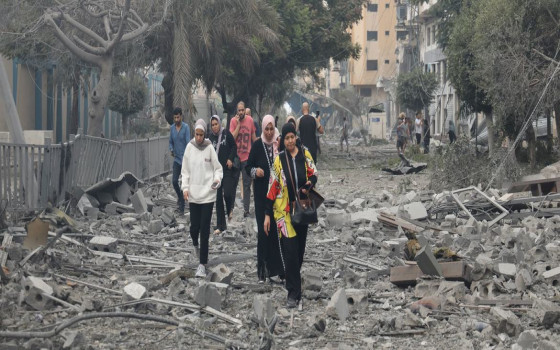
United Nations: The Israeli army is still demanding that residents in Gaza leave their homes. There are no safe places and we are trying to reach those in need. Only 15 trucks cross from Rafah every day.

- Europe and Arabs
- Friday , 27 October 2023 13:30 PM GMT
Capitals: Europe and the Arabs
The United Nations Humanitarian Coordinator for the Occupied Palestinian Territory said that the Israeli army continues to inform people in Gaza City that those who remain in their homes will be putting themselves in danger. She stated that advance warnings do not make any difference for those who cannot evacuate because they have nowhere to go or because they are unable to move. While the United Nations Office for the Coordination of Humanitarian Affairs reported that 62 trucks crossed the Rafah crossing from Egypt to the Gaza Strip over four consecutive days - since Saturday - carrying water, food and medical supplies.
In a press statement, Lynn Hastings said: “In some cases, the notification (from the Israeli army) urges people to go to a humanitarian area in Al-Mawasi,” located in southern Gaza.
She added that the United Nations is aware of the reference to the “humanitarian area in Al-Mawasi,” but it intends to deliver aid wherever those in need are.
The UN Resident Coordinator in Palestine said: “When evacuation routes are bombed and people in the north and south find themselves caught up in hostilities, when the basics of survival are no longer available, and when there are no guarantees of return, people are left with impossible options. There is no place.” Safe in Gaza.
Hastings added that the conduct of armed conflicts, anywhere, is subject to international humanitarian law, which means the necessity of protecting civilians and ensuring that they have the necessities necessary to survive, wherever they are, and whether they choose to move or stay.
She said this also means "all hostages must be released immediately and unconditionally."
In the same context, the United Nations Office for the Coordination of Humanitarian Affairs reported that 62 trucks crossed the Rafah crossing from Egypt to the Gaza Strip over four consecutive days - since Saturday - carrying water, food and medical supplies. United Nations spokesman Stephane Dujarric said that most of this aid has already reached hospitals, ambulances and internally displaced people.
But he pointed out that the daily average of trucks that were allowed to enter Gaza before the current hostilities was about 500 trucks.
He reported that fuel, which is badly needed to operate backup generators, was not brought in. As a result, the United Nations Relief and Works Agency for Palestine Refugees (UNRWA) had almost exhausted its fuel reserves and began to significantly reduce its operations.
The number of displaced people in the Gaza Strip is estimated at about 1.4 million people, about 629,000 of whom live in 150 UNRWA emergency shelters. Overcrowding is a growing concern, with the average number of displaced people per shelter now reaching 2.7 times its capacity.
Dujarric said that water supplies through the network had temporarily improved in areas south of Wadi Gaza, after UNRWA and UNICEF were able to deliver small quantities of fuel from their existing reserves to main facilities.
But he added that the fuel available at these facilities will likely run out very soon, and piped water supplies are expected to stop again.





No Comments Found