

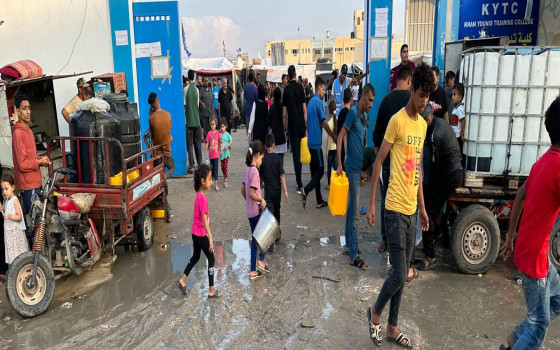
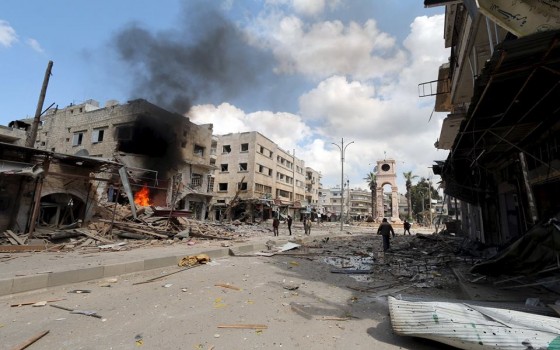
UN officials: The situation in Gaza has never happened before anywhere in the world, and there are no words to describe the devastation and destruction.

- Europe and Arabs
- Tuesday , 14 November 2023 14:28 PM GMT
Gaza - New York: Europe and the Arabs
The United Nations Humanitarian Coordinator for the Occupied Palestinian Territory said that the situation in Gaza “goes beyond what we have seen before, not only in the region, but almost anywhere in the world.”
Lynne Hastings, United Nations Resident and Humanitarian Coordinator in Palestine, noted that the “catastrophic devastation and destruction” that occurred in Gaza are beyond words to describe. According to what was stated in the United Nations' daily news bulletin, a copy of which we received this Tuesday morning after Hastings presented, yesterday, Monday, a review of the situation in Gaza and the West Bank and the humanitarian appeal launched by the United Nations and its partners to support 2.7 million people in the occupied Palestinian territory.
She pointed out that at least 10,000 Palestinians were killed, according to the Ministry of Health in Gaza, in addition to the killing of 1,200 Israelis, according to what was reported by the Israeli media.
The UN official said that the number of deaths in Gaza during the past five weeks is approximately equivalent to the number of people killed in Ukraine during 18 months, and the number of people killed in Sudan during six months of war.
UNICEF reported that 4,324 children had been killed in Gaza since the start of hostilities. This equates to the killing of 400 children every day.
Water shortage worsens the health situation
According to UN estimates, 55 percent of water supply infrastructure needs repair or rehabilitation.
Hastings said that the percentage of water consumed by people in Gaza is 90 percent less than the amount consumed in the period before October 7.
Water desalination plants are not working, forcing people to use unhealthy water sources, which she said is expected to exacerbate the health crisis in the sector in conjunction with the closure of many services, including hospitals.
So far, two-thirds of primary health care centers have been closed and nurseries are no longer functioning, putting newborns at risk of death. She referred to reports that some of them had died.
The UN Coordinator stressed the necessity of opening the crossings for the entry of commercial goods into Gaza, with the aim of strengthening and completing the work carried out by humanitarian workers.
She warned that relief workers alone cannot support and sustain the lives of 2.2 million people, noting that the needs today are much higher than they were before.
Even before the current crisis, she said, we were not expected to support 2.2 million people, “and we certainly cannot now with the significant increase in humanitarian needs.”
She stated that the United Nations provides shelter and assistance to about 778,000 people through 154 facilities.
Hastings noted that 981 humanitarian aid trucks have crossed into Gaza from Rafah - an average of about 40 trucks per day since October 21, compared to about 550 trucks that entered the Strip on a daily basis before October 7.
She said that the United Nations was not able to bring everything that people needed into Gaza due to the strict closure, noting that even before the current crisis, people were suffering from high rates of poverty and malnutrition.
She stressed the importance of the partnership between the humanitarian and commercial sectors, “which was happening before October 7.”
“The escalation of hostilities in Israel and Palestine has a significant impact on all dimensions of food security,” said Qu Dongyu, Director-General of the United Nations Food and Agriculture Organization (FAO).
The UN official explained in a statement that even before the escalation, about 60 percent of families in Gaza were suffering from food insecurity or were vulnerable to it, pointing to the collapse of agricultural and food activities in Gaza since the beginning of the current hostilities and the interruption of water, food and fuel supplies.
Fisheries and livestock activities and the production of fresh fruits and vegetables have also stopped, preventing access to vital sources of protein and nutritious food, as well as major sources of employment and livelihood opportunities.
Qu Dongyu said that the organization considers that the entire civilian population in Gaza is suffering at this stage from food insecurity.
He stressed the organization's full commitment with its partners in the humanitarian field to meet the urgent humanitarian needs of the population in the Gaza Strip and the additional needs emerging in the West Bank to protect and restore agricultural-based livelihoods.
He said that FAO was mobilizing vital agricultural supplies for transport to Gaza as soon as access was available. In addition, FAO will support assessments related to the agricultural sector as soon as conditions permit. It also monitors the impact of hostilities on food security in the region and beyond.
The FAO Director reiterated the organization's full commitment to continuing and expanding the assistance provided to the Palestinian people, and taking all necessary measures to do so within the framework of the organization's mandate.
He concluded his statement by saying: “Providing water, food, medicine and fuel is an urgent and obvious priority to alleviate human suffering, but we should not forget the importance of emergency agricultural aid for survival.”





No Comments Found